Neuro-Symbolic AI Explained: Teaching a Network to Follow the Rules
A beginner-friendly tour of neuro-symbolic AI: why neural networks perceive brilliantly but can't guarantee anything, why symbolic engines reason perfectly but can't see, and how the field is finally joining the two — with calibrated confidence as the glue at the seam.
Level: Beginner | Part of artifocial W32 Basics
The Student Who Never Shows Their Work
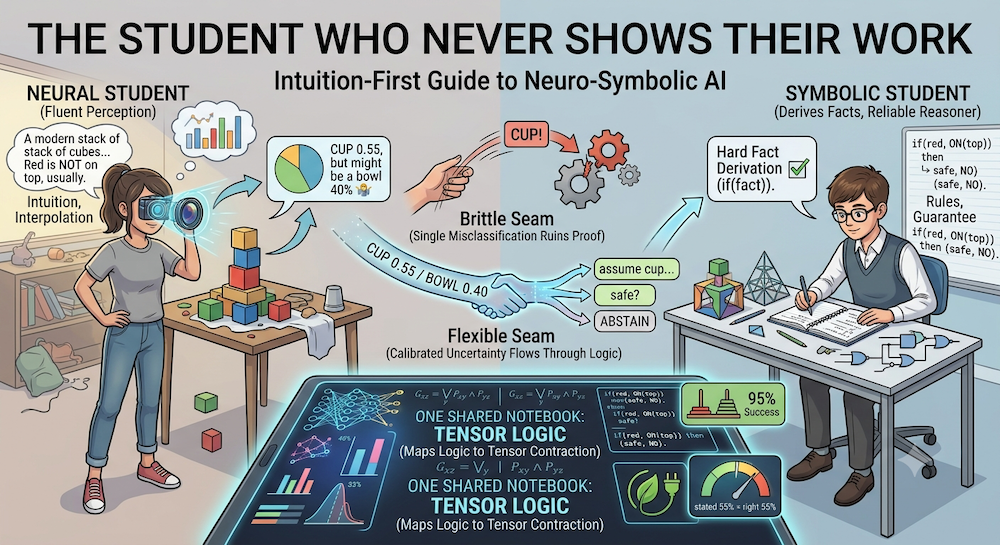
Imagine two very different students. The first has read everything and has an uncanny eye — glance at a photo and she names every object, reads the mood, describes the scene in fluent prose. But ask her to prove that stacking the blocks a certain way keeps the red one off the top, and she shrugs: "It usually works out." She has intuition, not guarantees.
The second student is the opposite. Give him clean facts and a rulebook and he will derive every valid conclusion perfectly, showing every step of his work. But he cannot look at the photo at all. Hand him a wrong fact — "that's a cup" when it was a bowl — and he'll reason flawlessly straight to a wrong answer, with total confidence and no idea anything went wrong.
Modern AI has these two students, and for fifty years it has wanted to make them work together. That collaboration is neuro-symbolic AI. This week's advanced companion goes deep on the newest math for it; here we'll build the intuition from the ground up.
Two Waves, Two Failure Modes
The history of AI is largely the story of these two students taking turns.
Wave one was symbolic. From the 1950s through the 1980s, AI was logic and rules. Expert systems encoded human knowledge as explicit if-then statements; programs in languages like Prolog and Datalog derived conclusions from facts with mathematical certainty. This is our second student. It reasons reliably and can explain itself — but it is blind and brittle. Someone has to hand-feed it clean symbols, and the real world refuses to arrive pre-labeled.
Wave two was neural. From roughly 2012 onward, deep learning flipped the script. Instead of hand-written rules, we let networks learn patterns from mountains of data. This is our first student: give a modern network a photograph and it perceives fluently. But it is a champion interpolator, not a reasoner. It answers with a likelihood, never a guarantee, and — as we saw across the last two weeks — it tends to be overconfident exactly when it's wrong.
Each wave's strength is the other's blind spot. Symbolic AI reasons but can't perceive; neural AI perceives but can't guarantee. The obvious move is to combine them — and that combination is the third wave the field is now living in.
Why the Obvious Combination Kept Failing
The recipe sounds easy: put a neural network at the front to turn pixels into symbols, and a symbolic reasoner at the back to draw conclusions. Perception, then logic. People have been trying this since the 1980s.
It keeps breaking in the same place — the seam between the two halves. The neural front-end emits a hard label: "cup." The symbolic back-end takes that label as gospel and reasons from it. So a single overconfident misclassification sails through the logic and comes out the other end as a confidently wrong answer. The reasoner never had a way to know the label was shaky. The join had no notion of doubt.
That is the real lesson of the field's long frustration: it was never enough to bolt a network to a rulebook. The two students weren't just speaking different languages — the handoff between them threw away the one piece of information that would have saved the whole chain: how sure was the perception, really?
The Glue Is the Thing We Just Built
Here is where our recent weeks pay off. Week 28 and Week 29 were all about teaching models to say how sure they are — and to say it honestly, so that a stated confidence of 55% really does mean right-about-55%-of-the-time. That property has a name, calibration, and it turns out to be exactly the glue the seam was missing.
Watch what changes. Instead of the neural student blurting "cup," she now says "cup, 55% — but it might be a bowl, 40%." Now the symbolic student has something honest to work with. He can carry that doubt through his reasoning and report a hedged conclusion: "the grasp is safe — assuming it's a cup, which we're only 55% sure of." Or, when confidence is too low, he can do the smartest thing of all: abstain — stop, and ask for another photo before committing.
Calibrated confidence turns the brittle seam into a flexible one. It doesn't magically solve everything — you still have to design how the doubt flows through the logic — but it converts "one wrong label ruins everything" into "shaky labels get flagged, reasoned around, or refused." A recent survey of neuro-symbolic uncertainty makes this its central point: soft, probabilistic predicates feeding confidence thresholds in the symbolic layer, and it's the calibration of those numbers that decides whether the thresholds mean anything.
One Language for Both Halves
The freshest idea in the third wave goes further still: what if the two students didn't pass notes across a wall at all, but shared one notebook? Pedro Domingos's Tensor Logic (October 2025) makes a startling observation — with the right encoding, a logical rule can be carried out by the very same operation as a matrix multiplication. Chaining "a parent of a parent is a grandparent" through the family tree turns out to be, mathematically, the same kind of index-summing that a neural network already does millions of times a second. The two aren't identical in every sense — the claim is that logic maps onto tensor contraction, not that all matrix math is secretly logic — but the overlap is deep enough to build on. If logic and learning are the same underlying math, you can do both inside one computation graph — and train the perception and the reasoning together instead of gluing them after the fact. Our companion notebook builds this in miniature so you can watch a "grandparent" rule fall out of a single tensor contraction, matching a hand-written logic loop step for step.
Why Bother? The Payoff Is Getting Concrete
This isn't just elegant — it's increasingly a matter of cost. In April, Matthias Scheutz's lab at Tufts reported a neuro-symbolic robot system that hit 95% on the Tower of Hanoi puzzle against 34% for a comparable pure-neural system — while training in 34 minutes instead of 36-plus hours and using roughly 1% of the training energy (ScienceDaily, April 2026). When a task has real structure, encoding that structure as symbols isn't nostalgia — it's dramatically cheaper and more reliable than asking one giant network to rediscover logic from scratch.
The honest caveats stay on the table: Tower of Hanoi is highly structured, and whether the win survives messy, open-ended tasks is still an open question. Symbolic layers have been promised for thirty years. But the direction is clear, and — as this week's arc argues — the piece that finally makes the join work is the humble, honest confidence number we spent the last two weeks learning to compute.
What You'll Build This Week
Two small, laptop-friendly notebooks make it tangible:
- Tensor Logic from scratch — implement the "grandparent" rule as a single tensor operation and watch it agree, exactly, with a hand-written logic loop.
- Confidence-gated inference — feed a deliberately noisy neural "perceptron" into a symbolic step, and see the difference calibration makes: the uncalibrated version reasons confidently into errors, while the calibrated one correctly says "I'm not sure — let me abstain."
That last line is the whole point of neuro-symbolic AI in one sentence: not a machine that always answers, but one that knows when it has earned the right to.
This tutorial is part of the artifocial research-multimodal series. This week's advanced companion: Reasoning on Purpose: Neuro-Symbolic AI and the Confidence to Act. Previous basics: Bayesian Rendering Explained.
Build with AI — early access
Curious how reasoning systems like this actually get built and shipped? Build with AI is our early-access program for engineers moving from tutorials like this to production AI — hands-on guidance instead of guesswork. Early access is opening now.