Reasoning on Purpose: Neuro-Symbolic AI and the Confidence to Act
Neural networks perceive fluently but hallucinate confidently; symbolic engines reason reliably but shatter on noisy inputs. This week we join the two — and argue the hinge that makes the join work is the calibrated uncertainty we built last week. From Tensor Logic's single equation to confidence-gated inference, here is how AI reasons about what it sees.
W32 Trend Tutorial | Difficulty: Advanced | Research area: Neuro-symbolic reasoning
Where the Arc Has Taken Us
Three weeks ago we reframed attention as kernel regression and argued that scale quietly abandoned a tool it needs: calibrated uncertainty. Last week we watched a point-estimate 3D scene hallucinate floaters into regions no camera constrained, and fixed it by putting a distribution over the geometry. Both weeks ended on the same note — a model that knows what it doesn't know is worth more than a model that is merely confident.
This week we ask what that knowledge is for. A calibrated confidence number is not the goal; it is a permission slip. The question W32 answers is: permission to do what? Our answer is reasoning. Calibrated uncertainty is precisely the ingredient that lets a fluent-but-fallible neural perceptron hand its outputs to a rigid-but-reliable symbolic reasoner without the whole chain collapsing on the first misread pixel.
Two Kinds of Intelligence, Two Failure Modes
The oldest tension in AI is still the live one. A deep network is a magnificent interpolator: give it a photo and it will name the objects, ground the referring expression, and describe the scene in prose. What it will not do is guarantee anything. Ask it to stack three blocks so the red one is never on top and it will usually comply and occasionally, fluently, violate the constraint — because "usually" is all a likelihood-maximizer promises.
A symbolic engine is the mirror image. Give a Datalog or Prolog program the fact on(red, blue) and a rule, and it will derive every consequence with total reliability and a full proof trace. What it will not do is look at a photograph. It needs the world pre-digested into clean symbols, and the moment perception feeds it a wrong symbol — cup when the object was a bowl — it reasons flawlessly to a wrong conclusion and reports no doubt at all.
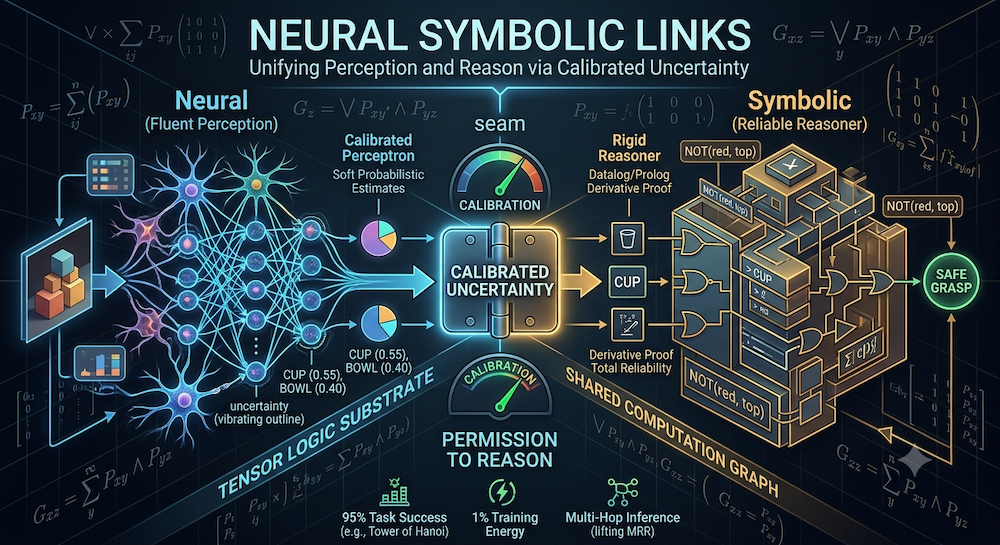
Neuro-symbolic AI is the fifty-year-old dream of gluing the two: neural front-end for perception, symbolic back-end for inference. The dream keeps failing at the seam. The neural side emits a hard label; the symbolic side consumes it as gospel; a single overconfident misclassification propagates through the proof and out the other end wearing a suit and tie. The seam has no notion of "this predicate is shaky — reason around it, or abstain."
The Missing Ingredient Is the One We Just Built
Here is the claim this week turns on. The seam needs calibrated uncertainty, and that is exactly what the last two weeks produced. If the neural perceptron reports not cup but cup with probability 0.55, bowl with 0.40 — and if that 0.55 is honest, in the calibration sense that predictions of 0.55 are right about 55% of the time — then the symbolic layer has something to work with. It can treat the predicate probabilistically, propagate the doubt through the inference, and surface a conclusion that is itself hedged: "the grasp is safe, assuming the object is a cup, which I am only 55% sure of." A recent survey of neuro-symbolic AI for uncertainty quantification frames this exactly: neural modules emit soft probabilistic estimates that feed symbolic layers equipped with confidence thresholds and probabilistic-logic rules, and it is the calibration of those estimates that decides whether the thresholds mean anything.
The corollary is the sharper one. Miscalibration at the seam is not a nuisance; it is the defect that has quietly sabotaged neuro-symbolic systems for decades. A neural front-end that is systematically overconfident hands the reasoner false certainties, and no amount of logical rigor downstream can recover information the perceptron threw away. Calibration is necessary here, though not sufficient — it earns the perceptron the right to be trusted, but wiring that trust into inference still takes deliberate design (more on that below). Much of what we did in W28 and W29 — GP posteriors, Fisher-information confidence maps, abstention on high-entropy predictions — reads, in hindsight, as infrastructure for this week. Recent work on teaching LLMs to abstain via calibrated semantic confidence is the same move at the language layer: reallocate probability mass toward "I don't know" precisely when the model is uncertain, so the reasoning that follows is built only on predicates it can stand behind.
Tensor Logic: One Equation for Both Sides
If calibration is the hinge, we still need a substrate — a place where the neural and symbolic halves can share a computation graph rather than passing strings across a wall. The most striking recent proposal is Pedro Domingos's Tensor Logic: The Language of AI (October 2025), and its argument is disarmingly simple.
Domingos observes that a logical rule and an Einstein summation are the same operation. Consider the classic rule for grandparenthood: grandparent(x, z) ← parent(x, y) ∧ parent(y, z). Encode the parent relation as a boolean matrix where iff is a parent of . Then the grandparent relation is nothing more than the matrix product — a contraction over the shared index , which is exactly what a matrix multiply (or an attention score, or a graph-convolution step) computes. The only difference is the algebra you contract in: a standard matmul sums products over the real numbers, while this "logical matmul" runs the same contraction over the Boolean semiring, with in place of and in place of . Joining on a variable is summing over a tensor index — and swapping the semiring smoothly interpolates between hard logic and soft, differentiable inference. From this single observation Domingos builds a language whose sole construct is the tensor equation, and shows that neural networks, symbolic AI, kernel machines, and graphical models are all special cases of it.
The follow-up implementation paper, Implementing Tensor Logic (January 2026), makes this concrete rather than aspirational. On a genealogy graph of 1,972 individuals, recursive Datalog rules and iterative tensor contractions produce identical results — 74 iterations of the tensor recurrence converge to the same 33,945 ancestor relationships the logic program derives. And because the tensors are the same objects a neural network learns, the framework does link prediction on FB15k-237 (14,541 entities, 237 relations) at an MRR of 0.3068 — in the same range as mainstream knowledge-graph embedding baselines, so the interesting comparison is not against them but against itself: the score rises to 0.3346 on compositional queries whose direct training edges were deleted, because matrix composition performs multi-hop inference the training set never demonstrated. That within-system lift is the whole point in miniature: a system that reasons its way to answers it was never shown, inside a differentiable graph you can also train.
Why This Matters Beyond Elegance
Unification is pretty, but the case for neuro-symbolic AI in 2026 is increasingly an economic one. In April, Matthias Scheutz's lab at Tufts reported a neuro-symbolic vision-language-action system — neural perception, explicit symbolic task reasoning — that hit 95% on Tower of Hanoi (a structured multi-step planning task) against 34% for a comparable pure-neural baseline, trained in 34 minutes instead of 36-plus hours, using roughly 1% of the training energy and 5% of the inference energy (ScienceDaily, April 2026; ICRA 2026). Read those numbers as a thesis: when a domain has exploitable structure, encoding that structure as symbols is not a nostalgia trip — it is two orders of magnitude cheaper and dramatically more reliable than asking a monolith to rediscover logic from scratch.
The honest caveats belong in the tutorial too. Tower of Hanoi is highly structured; the open question is whether the advantage survives open-ended manipulation where clean symbols are hard to name. Symbolic layers have been promised for thirty years. And a shared tensor substrate does not, by itself, solve the seam — it just moves the calibration problem inside one graph instead of across a wall, which is progress precisely because you can now train the confidence and the inference together.
What We Build This Week
The companion notebooks make the two halves tangible on a CPU:
- NB 00 — Tensor Logic from scratch. We implement the grandparent rule as an Einstein summation over a boolean adjacency tensor, watch a recursive
ancestorrelation converge by repeated contraction (the genealogy result above, in miniature), and confirm bit-for-bit that the tensor recurrence and a hand-written Datalog loop agree. - NB 01 — Confidence-gated inference. We take a deliberately noisy neural "perceptron," calibrate it with the temperature scaling from W28 (the one-parameter rescaling of the logits that makes a model's stated confidence match its actual accuracy), and feed its soft predicates into the symbolic step — showing that an uncalibrated front-end pushes the reasoner into confident errors while a calibrated one correctly abstains, exactly where W29's uncertainty map said it should.
Next Week
W32 turned calibrated confidence into reliable inference. W33 closes Arc 2's loop: a probabilistic world model that perceives, reasons, and acts — using the uncertainty it carries to decide not just what is true, but what to do next.
This tutorial is part of the artifocial research-multimodal series. Previous: W29 Trend Tutorial — When Gaussians Get Uncertain. Next: W33 Probabilistic World Models That Act (coming soon).
Build with AI is opening to early users. If you want to put neuro-symbolic reasoning, calibrated uncertainty, and the rest of this series to work in your own projects, join the waitlist →