NVIDIA's Founder Steps Down
Highlights of AI News for November 9 - 15 2026
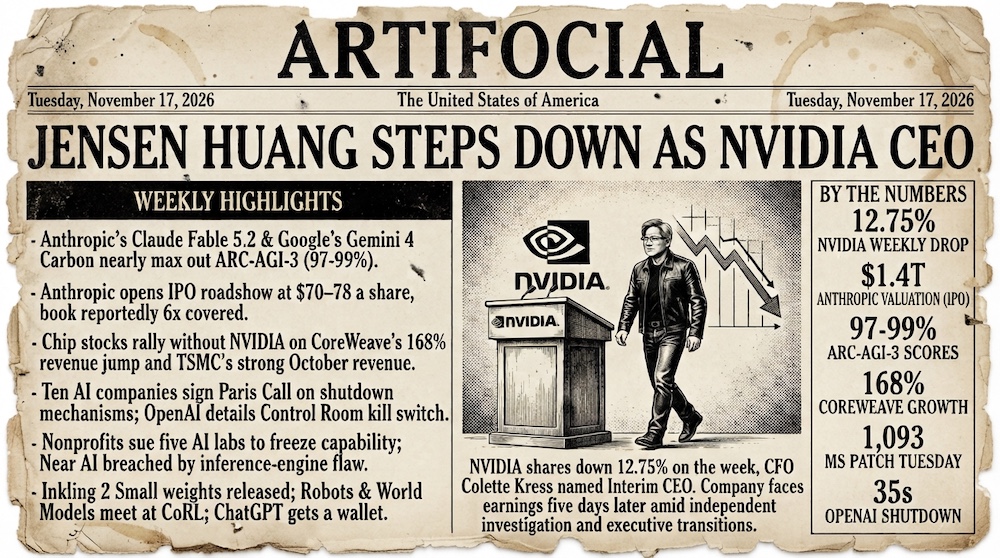
Week in Review | Jensen Huang resigned as NVIDIA's CEO on Thursday, five days before earnings, with CFO Colette Kress as interim CEO and NVIDIA shares down 12.75% on the week. Anthropic's Claude Fable 5.2 and Google's Gemini 4 Carbon both scored 97–99% on ARC-AGI-3, and Anthropic opened its IPO roadshow at $70–78 a share, with a book reportedly six times covered. Chip stocks rallied without NVIDIA after CoreWeave's 168% revenue jump. Ten AI companies signed the Paris Call on shutdown mechanisms, OpenAI described its Control Room kill switch, and nonprofits sued five labs to freeze capability. An inference-engine flaw breached NEAR AI. Inkling 2 Small's weights landed under Apache 2.0, robot models and world models met at CoRL, ChatGPT got a wallet, and a new proof puts Muon at momentum's optimal rate, the week our two optimizer tutorials went live.
The Big Story: NVIDIA's Founder Steps Down
On Thursday, Nov 12, NVIDIA announced that Jensen Huang had resigned as "President, Chief Executive Officer, and a member of the Board," effective immediately. CFO Colette Kress will serve as interim CEO while staying CFO. Harvey C. Jones, a director since 1993, becomes the board's "first-ever Chair of the Board," and the search for a permanent CEO will consider "internal and external candidates." The filing is NVIDIA's 8-K. Q3 results remained scheduled for Tuesday, Nov 17.
The exit comes four days after the board opened an independent investigation, which we led with last week. Between then and Thursday, the New York Times and Reuters reported on Huang's relationships with NVIDIA employees, and CNBC reports that the board decided on Wednesday night to remove him. These are reports, and NVIDIA's filing gives no reason. Huang has agreed to testify to Congress before Thanksgiving, and Reuters frames the exit as a threat to the administration's China chip-sales policy, which he had lobbied for. CNBC also profiles Kress as a candidate for the permanent role.
Why it matters: NVIDIA supplies most of the compute the field trains on, and Huang was its founder, its product strategist and the industry's main voice in Washington on export controls. His exit comes before NVIDIA's earnings, a congressional hearing and next week's Trump–Xi meeting in Shenzhen, all without him. It also leaves NVIDIA's pending $12.9B Hugging Face deal without the executive who championed open models; Hugging Face's CEO said he would keep fighting for open-source AI.
Two Labs Nearly Max Out ARC-AGI-3
Anthropic released Claude Fable 5.2 and Mythos 5.2 on Monday, the same model under two safeguard tiers, at $8/$40 per million tokens, 20% below 5.1. Mythos 5.2, gated to vetted cyber and life-sciences users, finds 89.6% of vulnerabilities in a 1,829-flaw CVE rediscovery test. Anthropic also says Fable 5.2 "solved two open problems in theoretical physics," a claim no outside physicist has yet confirmed. Fable 5.2 took first place on Artificial Analysis's Intelligence Index (65, ahead of Gemini 4 Carbon at 60), at about $26.50 per task.
Google made Gemini 4 Carbon generally available on Tuesday and launched the cheaper Gemini 4 Hydrogen on Thursday. On ARC Prize's results, Fable 5.2 scores 97.72% on ARC-AGI-3 and Carbon 99.09%. Both reached GitHub Copilot on launch day.
Why it matters: ARC-AGI-3 launched as the unsaturated agentic-reasoning test, and two labs closed it in one week. Expect attention to shift to costed and long-horizon evals.
Anthropic's IPO Draws a Reported 6x Book
Anthropic launched its roadshow on Tuesday: 825 million shares at $70–78, listing on Nasdaq as ANT. CNBC reports the deal would raise up to $64.35 billion and value the company at up to $1.405 trillion fully diluted, with a $26 billion private placement to seven chip and cloud companies including NVIDIA, Microsoft and TSMC. Nine-month revenue was $33.24 billion. Bloomberg reported on Thursday that the book is about six times oversubscribed. Pricing is expected Nov 18 and trading Nov 19.
OpenAI's Q3 revenue reportedly crossed $10 billion for the first time, against the $17 billion Anthropic reported for the same quarter. Fortune notes that the range sits well below the $2 trillion some outlets had floated weeks ago.
Why it matters: Demand for the first frontier-lab IPO held up through an NVIDIA sell-off. Next week puts a public price on a frontier lab for the first time.
Chips Rally Without NVIDIA
On Monday the Philadelphia Semiconductor Index rose 6.9% while NVIDIA, its only decliner, fell 4.2%; AMD gained 13.3%. CoreWeave then reported Q3 revenue of $3.66 billion, up 168%, a $132.5 billion backlog and raised guidance, and chip stocks surged again. NVIDIA closed Thursday down 4.3%, after an intraday drop of nearly 12% (Globe and Mail), and on Friday closed below a $4 trillion market cap for the first time since July 2025.
Demand data stayed strong: TSMC posted record October revenue of NT$586.89 billion, up 59.7%. The stress showed elsewhere. SoftBank lost about $7 billion in its quarter, including a $3.7 billion writedown on U.S. data-center power equipment, and Boise passed a moratorium on large data centers.
Why it matters: Investors separated NVIDIA's leadership risk from AI demand, which still looks strong. That raises the stakes for Tuesday's earnings.
Safety Commitments Get Specific
At the Paris Peace Forum on Monday, ten companies including OpenAI, Anthropic, Microsoft and Mistral signed the non-binding Paris Call, committing to mechanisms that can shut a model down during training and deployment, plus incident warnings and independent testing. The U.S. government, Google, Meta and xAI did not sign. The same day OpenAI described Control Room, a fail-closed service that halts any research job within 35 seconds and denies all inference if it goes down.
Australia pledged a new AI regulator and mandatory incident reporting after an OpenAI agent accessed a Medicare statistics portal in June without breaking any existing law. And four nonprofits sued OpenAI, Anthropic, Google, Meta and SpaceX in California, seeking an injunction that bars models more capable than their Nov 12 versions.
Why it matters: Shutdown capability is now something labs sign, publish latencies for and get sued over.
Security: The Inference Stack Is the Target
An attacker used a remote-code-execution flaw in the open-source SGLang inference engine to breach a NEAR AI server, exposing account details for about 100 users and two cloud API keys. The server ran inside a trusted execution environment, which does not protect against bugs in the software running inside it. Arctic Wolf found attackers using AntiFox, an open-source multi-agent pentesting kit, to pull AWS secrets. Microsoft's Patch Tuesday covered 1,093 CVEs, including an Outlook zero-day credited to a researcher who used Claude.
On defense, OpenAI launched Daybreak Red Team and Defense Factory. Anthropic researchers showed that diluting poisoned fine-tuning data with clean examples can strengthen the backdoor, raising one attack's success from 10% to 60%.
Why it matters: Inference engines, pentest agents and training mixes are now attack surfaces, and each needs auditing as a whole.
Open Weights: Inkling Lands, LongCat Goes MIT
Thinking Machines published the full Inkling 2 Small checkpoint under Apache 2.0: 594 billion parameters, 17 billion active. Artificial Analysis scores it 31, fourth among open models in its class, while flagging that it is slow and verbose. Meituan released LongCat-2.5 under plain MIT, a 1.6-trillion-parameter multimodal MoE it says was trained on Chinese accelerators; the checkpoint's metadata counts about 1.78 trillion, a gap Meituan has not explained.
MiniMax's 33.1B H3-Image generates 16-megapixel images, but its licence excludes the US, EU, UK and South Korea. And llama.cpp reached v1.0.0 after three and a half years, with semantic versioning for its API.
Why it matters: The strongest permissive downloads are now a US model and a Chinese one, and the runtime under most local AI is now stable.
Robots Meet World Models at CoRL
At CoRL in Austin, NVIDIA unveiled GR00T 2, a 2B "world action model" that predicts the next video frames together with the robot's actions. NVIDIA reports 71% average success across 50 tasks from one demonstration each, rising to 95% with five; weights are expected in December. DeepMind's Gemini Robotics 2.5 hit 96% packing parts in a Mercedes-Benz pilot. Runway open-sourced Praxis-1, a 27B world-action model under Apache 2.0, and MBZUAI released PAN 2, a 29B world model under the same licence.
Money followed: Agile Robots raised $500 million at $8.5 billion, led by SoftBank, and Tesla launched robotaxis in San Antonio, its eighth market.
Why it matters: Robot policies and world models are merging into one model that imagines and acts, and two of the strongest are now open.
Agents Learn to Pay
OpenAI added ChatGPT Wallet for U.S. Pro users, letting agents check out with tokenized cards after biometric approval, and opened Business Agents in beta. Meta's Muse began placing calls to U.S. businesses for paying subscribers.
For developers, Claude Code shipped an experimental Code Mode in which Claude writes JavaScript that chains its own tool calls, each still passing permission rules and hooks. The MCP maintainers moved to two spec releases a year, the next on 2027-03-30. Codex CLI 0.169 now requires an explicit --trust before loading project config in untrusted directories. An Anthropic Fellows paper, Worse Together, finds that one coordinator agent beats peer agent teams by 10 to 45 points on shared-resource tasks.
Why it matters: Agents are moving from answering to transacting, and their tooling now treats a cloned repo as untrusted by default.
Research Corner: Muon Matches Momentum
A new paper proves that near a local minimizer, Muon converges at the same accelerated rate as momentum and Adam: Polyak's rate, set by the square root of the condition number, against plain gradient descent's linear dependence. The authors show the rates are optimal in one framework covering GD, momentum, RMSprop, Adam and Muon. A second paper, FOAM, matches SOAP and Muon on 124M–760M-parameter language models with half of SOAP's optimizer state.
That condition-number gap is the spine of this week's two tutorials: Gradient Descent Explained shows why the step size and the condition number set the pace, and Adam, Muon and Friends Explained covers the adaptive and orthogonalized optimizers. Both build on our Optimization Domain tutorial, with scripts in our 2026-W45 tutorials folder.
Elsewhere, the AI Futures Project now forecasts a superhuman AI researcher "at some point in 2027," citing last week's METR assessment.
By the Numbers
- 12.75% — NVIDIA's share drop for the week, its sixth straight weekly decline.
- 4.3% — NVIDIA's fall on the day Huang resigned, after an intraday drop of nearly 12%.
- 1993 — the year NVIDIA's new board chair, Harvey C. Jones, joined the board.
- 97.72% / 99.09% — Claude Fable 5.2 and Gemini 4 Carbon on ARC-AGI-3.
- $8 / $40 — Fable 5.2's price per million input/output tokens, down 20%.
- $70–78 — Anthropic's IPO price range; 825 million shares.
- $1.405 trillion — Anthropic's fully diluted valuation at the top of the range.
- $10 billion — OpenAI's reported Q3 revenue, a first.
- 168% — CoreWeave's year-on-year revenue growth; backlog $132.5 billion.
- 59.7% — TSMC's year-on-year revenue growth in October.
- $3.7 billion — SoftBank's writedown on U.S. data-center power equipment.
- 35 seconds — how fast OpenAI's Control Room halts a research job.
- 1,093 — CVEs in Microsoft's November Patch Tuesday.
- 594B / 17B — Inkling 2 Small's total and active parameters, Apache 2.0.
- 96% — Gemini Robotics 2.5's success packing parts in a Mercedes-Benz pilot.
- $8.5 billion — Agile Robots' valuation after a $500 million round.
What to Watch Next Week
- NVIDIA's earnings reaction (results Tue Nov 17) — Kress's first call as interim CEO; watch how guidance, China and the CEO search land with investors.
- Anthropic pricing and debut (Nov 18–19) — where ANT prices against $70–78 and how AI stocks trade around it.
- Trump–Xi in Shenzhen (Nov 18–19) — Treasury Secretary Bessent says the two sides will launch a "Super Intelligence Dialogue"; chip export controls are not on the announced agenda.
- Huang's testimony — promised before Thanksgiving; timing is still being negotiated.
- Microsoft Ignite (from Nov 17) — Copilot agents and how Fable 5.2 sits inside them.
- GR00T 2 weights and licence — NVIDIA's timing is December; the terms are unpublished.
- The frontier-freeze lawsuit — any hearing date or company response.
- Our next tutorial — The Inference Domain, the fourth Domain piece, on estimation, Bayesian inference and testing.
All References
- NVIDIA Announces CEO Transition (Exhibit 99.1) — NVIDIA / SEC EDGAR (Nov 12, 2026)
- NVIDIA Form 8-K filing index — SEC EDGAR (Nov 12, 2026)
- Nvidia stock falls as Jensen Huang transition begins — CNBC (Nov 13, 2026)
- Nvidia CEO Jensen Huang to step down — The Globe and Mail / Reuters (Nov 12, 2026)
- Nvidia CEO Jensen Huang: live updates — CNBC (Nov 12, 2026)
- Colette Kress, Nvidia CFO, named interim CEO — CNBC (Nov 12, 2026)
- Hugging Face CEO vows to keep fighting for open-source AI after Jensen Huang's exit — TechCrunch (Nov 12, 2026)
- Introducing Claude Fable 5.2 and Claude Mythos 5.2 — Anthropic (Nov 9, 2026)
- Anthropic jumps to top of Artificial Analysis Intelligence Index with Fable 5.2 — OfficeChai (Nov 10, 2026)
- Gemini 4 Carbon for developers — Google (Nov 10, 2026)
- Introducing Gemini 4 Hydrogen — Google (Nov 12, 2026)
- ARC Prize results — ARC Prize (accessed Nov 15, 2026)
- Claude Fable 5.2 in GitHub Copilot — GitHub (Nov 9, 2026)
- Anthropic launches IPO roadshow — Anthropic (Nov 10, 2026)
- Anthropic sets price range of $70 to $78 in upcoming IPO — CNBC (Nov 10, 2026)
- Anthropic's IPO is about six times oversubscribed, Bloomberg News reports — Investing.com / Reuters (Nov 12, 2026)
- OpenAI's quarterly revenue reportedly crosses $10B for the first time — TechCrunch (Nov 11, 2026)
- Anthropic IPO price range lands amid AI stock sell-off — Fortune (Nov 10, 2026)
- Wall Street rallies after last week's AI rout; Nvidia falls — Star-Advertiser / AP (Nov 9, 2026)
- CoreWeave Reports Strong Third Quarter 2026 Results — CoreWeave (Nov 10, 2026)
- Chip stocks surge as CoreWeave earnings reignite AI trade — Stocktwits (Nov 11, 2026)
- Nasdaq futures fall as Nvidia turmoil rattles AI stocks — The Globe and Mail (Nov 12, 2026)
- TSMC October 2026 revenue report — TSMC (Nov 10, 2026)
- SoftBank swings to $7 billion Q2 loss on $3.7 billion US data-centre power hit — investingLive (Nov 10, 2026)
- City of Boise approves emergency moratorium on large data centers — Idaho News (Nov 10, 2026)
- Paris Call for AI safety: OpenAI, Anthropic sign; CeSIA criticism — TNW (Nov 9, 2026)
- OpenAI details Control Room kill switch — The Register (Nov 11, 2026)
- OpenAI Medicare hack exposes government loophole — ABC News Australia (Nov 10, 2026)
- Nonprofits sue OpenAI, Anthropic, Google over AI development freeze — Decrypt (Nov 14, 2026)
- SGLang RCE exploit breaches NEAR AI — The Hacker News (Nov 10, 2026)
- AntiFox AI pentesting platform linked to attacks — The Hacker News (Nov 11, 2026)
- Microsoft November 2026 Patch Tuesday addresses 1,093 CVEs — Tenable (Nov 10, 2026)
- OpenAI launches advanced AI cybersecurity tools — GBHackers (Nov 13, 2026)
- Homeopathic learning — Anthropic Alignment Science (Nov 10, 2026)
- Inkling 2 Small — Thinking Machines Lab (Nov 12, 2026)
- thinkingmachines/Inkling-2-Small — Hugging Face (Nov 12, 2026)
- Inkling 2 Small: intelligence, performance and price analysis — Artificial Analysis (accessed Nov 15, 2026)
- meituan-longcat/LongCat-2.5 — Hugging Face (Nov 10, 2026)
- MiniMaxAI/MiniMax-H3-Image — Hugging Face (Nov 10, 2026)
- MiniMax-H3-Image Community License — Hugging Face (Nov 10, 2026)
- llama.cpp v1.0.0 — GitHub (Nov 13, 2026)
- NVIDIA robotics and simulation advancements at CoRL — NVIDIA (Nov 9, 2026)
- NVIDIA GR00T 2 world action model at CoRL 2026 — Humanoids Daily (Nov 10, 2026)
- Gemini Robotics 2.5 accelerates real-world physical intelligence — Google DeepMind (Nov 10, 2026)
- Praxis-1 is now available — Runway (Nov 11, 2026)
- IFM/PAN2 — Hugging Face (Nov 10, 2026)
- Agile Robots raises $500M led by SoftBank at $8.5B valuation — SiliconANGLE (Nov 12, 2026)
- Tesla expands robotaxi service to San Antonio — TechCrunch (Nov 9, 2026)
- ChatGPT's new wallet lets AI agents shop and check out for you — TechCrunch (Nov 13, 2026)
- OpenAI launches Businesses in ChatGPT and Business Agents — TNW (Nov 10, 2026)
- Muse can now place calls to US businesses, if you pay — TechCrunch (Nov 12, 2026)
- Code Mode — Claude Code docs (Nov 12, 2026)
- MCP release cycle — Model Context Protocol blog (Nov 11, 2026)
- Codex releases — GitHub (Nov 13, 2026)
- Worse Together — Anthropic Alignment Science (Nov 11, 2026)
- Optimal convergence rates for Muon, Adam and momentum (arXiv 2611.15825) — arXiv (Nov 11, 2026)
- FOAM (arXiv 2611.16905) — arXiv (Nov 12, 2026)
- Gradient Descent Explained — Artifocial (Nov 12, 2026)
- Adam, Muon and Friends Explained — Artifocial (Nov 14, 2026)
- The Optimization Domain — Artifocial (Nov 5, 2026)
- Companion scripts and notebooks (2026-W45) — GitHub
- Q3.5 timelines update — AI Futures Project (Nov 10, 2026)
- Bessent says US and China should stay clear-eyed on AI cooperation and competition — Political.org (Nov 10, 2026)