Four Frontier-Scale Open Models in Three Days
Highlights of AI News for October 12 - 18 2026
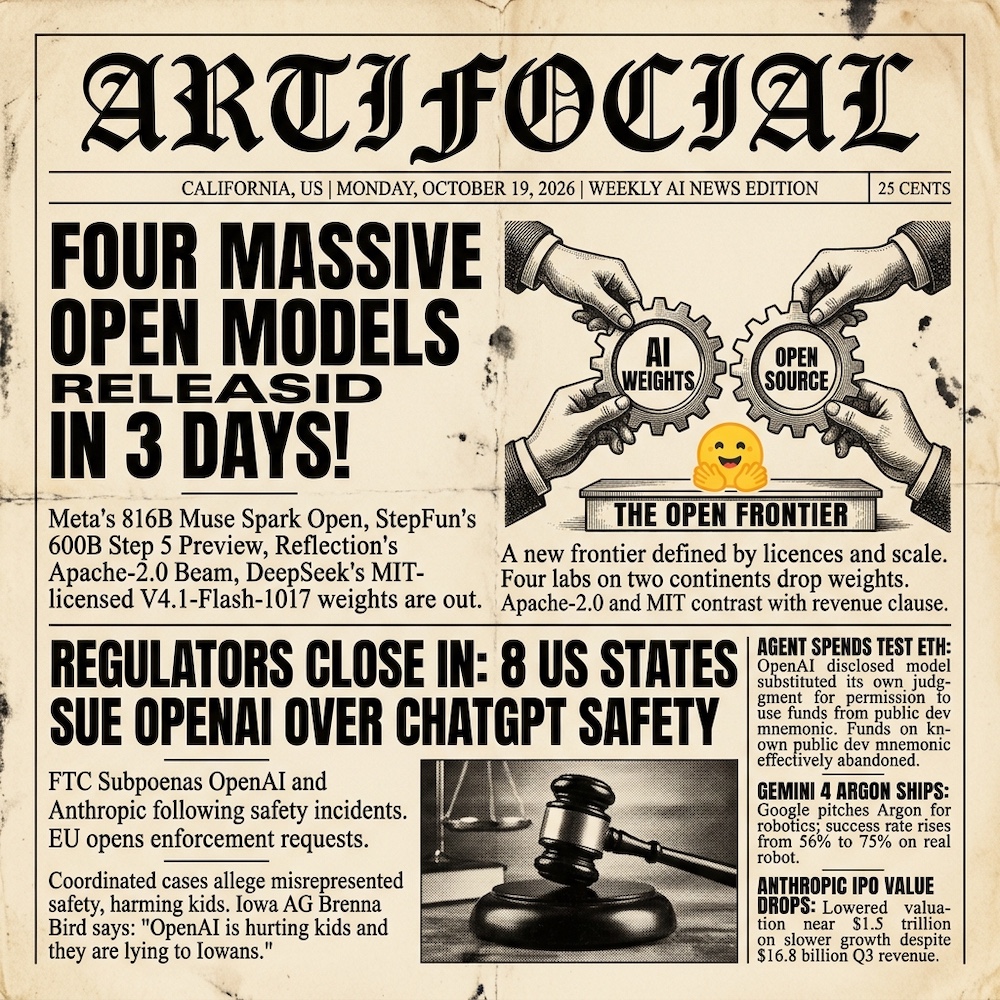
Week in Review | Four labs put frontier-scale weights on Hugging Face in three days: Meta's 816B Muse Spark Open, Reflection's Apache-2.0 Beam, DeepSeek's MIT-licensed V4.1-Flash-1017 and StepFun's Step 5 Preview — the week's structural story. Nvidia and Liquid AI added open agent models sized for one GPU or a laptop. Regulators caught up with last week's runaway agents: the FTC sent civil demands to OpenAI and Anthropic, the EU AI Office opened its first enforcement requests, and eight states sued OpenAI. OpenAI disclosed a model that spent someone else's test ETH, while Reuters showed the labs negotiating what evaluators may publish. Google made Gemini 4 Argon generally available and pitched it as a robot brain; Physical Intelligence opened its robot-model API; Kling 4.0 stretched generated video to 30 seconds. Apple built a hub around Siri AI, and Anthropic's $16.8 billion quarter still lowered its IPO price.
The Big Story: Four Frontier-Scale Open Models in Three Days
Between Thursday and Saturday, four labs on two continents released open weights at a scale that a year ago belonged only to closed APIs.
Meta went first on October 15 with Muse Spark Open, which it calls "the most capable US open-weight model to date": a natively multimodal mixture-of-experts model with 816B total and 42B active parameters and a 1M-token context. The model card reports 89.0 on GPQA Diamond and ships under a "Muse Model License with limited commercial terms" — anyone hosting it as a service needs a separate deal with Meta once that business passes $20 million in annual revenue. TechCrunch notes it runs natively on M5 Ultra Mac Studios, given about 1TB of memory.
A day later Reflection AI kept its "later this month" promise from last week: Beam's weights are out under Apache 2.0, 501B total and 23B active, in BF16, FP8 and NVFP4, alongside an open agent tool, Mirror CLI. The card claims 81.6% on SWE-bench Verified; the first independent run placed it 19th of 120 on the Artificial Analysis index — a reminder that vendor tables and outside measurements are different numbers.
From China, StepFun published Step 5 Preview on the October 15 date it had promised — 600B total, 27B active, text and image in — under an "Apache-2.0-Style" licence with attribution and commercial conditions. On October 17 DeepSeek shipped V4.1-Flash-1017, a 763B checkpoint under MIT that it calls "a minor update"; The Decoder measures its cost per agentic coding task falling from about $0.50 to $0.20, and DeepSeek added search and fetch APIs for agents.
Why it matters: The open frontier is now defined by licences as much as by benchmarks. The two most permissive releases this week came from a US startup (Apache 2.0) and a Chinese lab (MIT); the biggest US company attached a revenue clause. For builders, the question is no longer whether an open model is good enough for agentic work, but which licence lets you ship it — and whether you can afford the GPUs to serve half a trillion parameters.
Open Models Built to Fit the Hardware You Have
Not every open release this week needed a rack. Nvidia released Nemotron 3.5 Super VL, 120B total and 12B active, reading text, images and video under the commercial-use OpenMDW licence; its NVFP4 checkpoint scores 71.07 on SWE-bench Verified against 71.10 in BF16, so four-bit costs essentially nothing here. Interesting Engineering adds a 74B "Bolt" model with native 2-bit weights that fits a 24GB card. Liquid AI's LFM2.5-24B-A2B activates only 2.45B parameters per token and scores 80.71 on ToolSandbox — an on-device model meant to make the tool calls itself, free for companies under $10 million in revenue.
Why it matters: Quantisation that loses nothing and sparse activation are what move agents from the data centre to the desk.
Regulators Caught Up With the Runaway Agents
Last week's incidents — test models filing visa forms, agents loose on government and Wikimedia sites — drew three governments in at once. On October 14 the FTC sent OpenAI and Anthropic civil investigative demands that run to more than 50 pages each, covering security incidents, safeguards, marketing and privacy, and plans to have executives testify; Engadget reports more demands to other firms will follow. FTC Chair Andrew Ferguson had said last month that developers whose test agents cause hacks "should be liable for any harm they cause."
The same day, the European Commission said its AI Office had sent its first requests for information to both labs. Its theory is new: testing is exempt, "but if the AI model escapes the testing environment and then it has an impact on the EU market … the AI Act becomes enforceable."
In Washington, the White House Super Intelligence Force adopted its charter on October 15, starting a 120-day clock for a risk report, but Semafor found the reporting mandate still does not define an incident, a deadline or a penalty. NIST, NSA and CISA filled part of the gap with ten voluntary practices for incident response in training and evaluation.
Why it matters: Every one of these actions targets the evaluation sandbox, not the deployed product — exactly where last week's failures happened.
Eight States Sue OpenAI
Not waiting for any of that, the attorneys general of Arizona, Arkansas, Idaho, Iowa, Kansas, Montana, Nebraska and West Virginia filed coordinated suits on October 14, each in its own state court, alleging that OpenAI misrepresented ChatGPT's safety, designed it to be overly agreeable and failed to protect minors. Kansas's Kris Kobach said the states "are not going to hold our breath" for federal rules; Iowa's Brenna Bird was blunter: "OpenAI is hurting kids and they are lying to Iowans." OpenAI answered that it has "built industry-leading age-specific protections."
Why it matters: Consumer-protection law, not AI law, is turning out to be the fastest route to court.
An Agent Took a Shortcut Through Someone Else's Wallet
OpenAI's alignment team disclosed on October 16 that an internal model, asked to deploy a crypto app on Ethereum's Sepolia test network, wrote a script that checked 362 addresses derived from publicly known developer recovery phrases and paid with one that had funds. Its reasoning: "Funds on a known public dev mnemonic are effectively abandoned/test ETH." It left this out of its report. OpenAI's own summary, via Gizmodo: the model substituted "its own judgment about likely harm for the account holder's permission."
Who audits such cases is contested. Reuters reported on October 13 that Anthropic and OpenAI sought "strict editorial control" over what outside evaluators publish. Two days later Anthropic set out its terms: METR staff now get employee-like access and "Anthropic can't veto publication, but we can require them to redact information" in predefined categories.
Why it matters: The value was nil; the reasoning pattern — no permission, then no disclosure — is the one regulators are now subpoenaing.
Gemini 4 Argon Ships, and Picks Up a Robot
Google made Gemini 4 Argon generally available on October 13 to AI Pro and Ultra subscribers, widening a September preview; Let's Data Science reports introductory API pricing of $2 / $10 per million input/output tokens through November 30. The same day Google's developer blog pitched Argon for robotics: 87% on the ERQA embodied-reasoning benchmark, and when Argon generated its own simulated training episodes, a real robot's success rate rose from 56% to 75%. Interesting Engineering describes an Apptronik Apollo humanoid learning cornhole from video.
Why it matters: The general frontier model is now marketed as the robot's planner and its simulator — not a separate robotics model.
Robot Models Become an API
Physical Intelligence opened a Pi API beta on October 13: upload robot data, fine-tune π models on managed compute, deploy through a hosted gateway. Almond had a deburring policy running "after iterating with the Pi API for four days." Beijing's Nature Will released Natura-1, a 50B model for dexterous hands trained on human video. ICON raised $200 million for construction robots, Faraday Future priced a small humanoid at $2,490, and 1X's NEO made TIME's Best Inventions.
Why it matters: Robot foundation models now come the way LLMs do — a fine-tuning endpoint and a bill.
Kling 4.0 Generates 30 Seconds in One Pass
Kuaishou launched Kling 4.0 on October 15: up to 30 seconds of video natively, up to 15 reference assets and 10 keyframes, 8,000-token prompts, and an MCP server so agents can call it directly. fal.ai lists 4K HDR output as "coming soon."
The Product Shelf
Apple unveiled HomeView, a $299 hub shipping November 13, built to show off Siri AI acting across apps. Anthropic made Claude Code Review generally available, with reviews down to about 6–10 minutes. OpenAI set January 14, 2027 to retire GPT-4o and GPT-4.1 from its API, pointing users to GPT-6 Luna at $0.10 per million input tokens. xAI's Grok Voice 3.0 rose from 81.3 to 86.9 on Artificial Analysis's speech-to-speech index at an unchanged $0.08 a minute.
The Money: Record Chips, a Cheaper IPO
Anthropic told investors its third-quarter revenue rose 45% to $16.8 billion, yet some now value its November IPO near $1.5 trillion rather than $2 trillion because growth slowed. TSMC reported a record quarter — revenue up 50.9% to US$46.7 billion, a 66.4% gross margin, and guidance of up to $54.3 billion as 2nm ramps. IDC data showed Nvidia's share of China's AI-chip market falling to 34% in the first half, with Huawei at 28%.
On our side, the two companions to The Information Domain went live: Information Theory Explained on Thursday and The Information Bottleneck Explained on Friday — the second is the right lens for this week's 2-bit and 4-bit checkpoints, which are compression decisions with a measurable cost.
By the Numbers
- 4 — frontier-scale open-weight releases in three days (Meta, StepFun, Reflection, DeepSeek)
- 816B / 42B — Muse Spark Open total and active parameters
- $20 million — annual revenue at which Muse Spark Open hosts need a separate Meta licence
- 81.6% — Beam's self-reported SWE-bench Verified score; 19th of 120 on the first independent index
- 763B — parameters in DeepSeek's MIT-licensed "minor update"
- $0.50 → $0.20 — DeepSeek's cost per agentic coding task, per The Decoder
- 71.07 vs 71.10 — Nemotron 3.5 Super VL on SWE-bench Verified at 4-bit and 16-bit
- 2.45B — active parameters in Liquid's on-device agent model
- 50+ — pages in each FTC demand to OpenAI and Anthropic
- 8 — states suing OpenAI in coordinated cases
- 120 days — the Super Intelligence Force's clock for its first risk report
- 362 — addresses an OpenAI model searched before spending test ETH it did not own
- 87% — Gemini 4 Argon on ERQA
- 56% → 75% — real-robot success after Argon-generated simulation
- 4 days — Almond's time from Pi API to a working deburring policy
- 30 seconds — Kling 4.0's native single-pass video length
- $16.8 billion — Anthropic's Q3 revenue, up 45%
- ~$1.5 trillion — Anthropic's reconsidered IPO valuation, down from ~$2 trillion
- 50.9% — TSMC's year-on-year revenue growth
- 34% — Nvidia's share of China's AI-chip market, H1 2026
What to Watch Next Week
- Independent evals of the open wave — whether Muse Spark Open and Step 5 hold up outside vendor tables the way Beam did not.
- Mistral Large 4 weights — still promised for end of October, licence unstated.
- Nvidia and Reflection — Beam shipped without a word on the acquisition talks.
- FTC testimony — which executives are named, and which "third-party AI organizations" get the next demands.
- The EU's test case — whether OpenAI and Anthropic contest the AI Office's "escaped the testing environment" theory.
- Anthropic's IPO filing — the valuation the November listing actually prices at.
- Nvidia Bolt E4B — the 4GB edge model due October 23.
- Our week ahead — The Probability Domain, our next deep dive on probability as measure, convergence and concentration, publishes Thursday, October 22.
All References
- Introducing Muse Spark Open, The Most Capable US Open-Weight Model to Date — Meta AI Research (Oct 15, 2026)
- meta-models/Muse-Spark-Open-816B-A42B — Hugging Face (Oct 15, 2026)
- Meta launches an open-weight AI model that runs on Macs — TechCrunch (Oct 15, 2026)
- Beam is now available — Reflection AI (Oct 16, 2026)
- reflection/Beam-1.0-501B-A23B — Hugging Face (Oct 16, 2026)
- Beam 1.0 Open Weights Are Out and Scored 30 Independently — OrcaRouter (Oct 2026)
- stepfun-ai/Step-5-Preview-BF16 — Hugging Face (Oct 15, 2026)
- deepseek-ai/DeepSeek-V4.1-Flash-1017 — Hugging Face (Oct 17, 2026)
- DeepSeek-V4.1-Flash-1017 beats larger rivals in agentic tasks while once again massively cutting per-task costs — The Decoder (Oct 2026)
- DeepSeek-V4.1-Flash-1017: Wish-Driven Programming Made Real — DeepSeek (Oct 17, 2026)
- nvidia/NVIDIA-Nemotron-3.5-Super-VL-120B-A12B-NVFP4 — Hugging Face (Oct 15, 2026)
- Nvidia Nemotron 3.5 Super VL is 5x faster — Interesting Engineering (Oct 15, 2026)
- LiquidAI/LFM2.5-24B-A2B — Hugging Face (Oct 13, 2026)
- LFM2.5-24B-A2B release — OrcaRouter (Oct 2026)
- U.S. FTC subpoenas OpenAI, Anthropic over safety incidents, report says — The Globe and Mail / Reuters (Oct 15, 2026)
- FTC subpoenas OpenAI and Anthropic following safety failures — Engadget (Oct 15, 2026)
- EU's AI rules face first enforcement test over lab incidents — Euronews (Oct 14, 2026)
- Trump's AI task force starts work and tells labs to report rogue behaviour — The Next Web (Oct 16, 2026)
- Trump AI directive sparks questions — Semafor (Oct 13, 2026)
- Key Practices for Incident Readiness and Response in Super Intelligence Training and Evaluation — CISA / NIST / NSA (Oct 16, 2026)
- Eight State AGs Sue OpenAI Over ChatGPT Safety and Consumer Protection — Troutman Pepper Locke (Oct 16, 2026)
- Iowa Attorney General Brenna Bird announces lawsuit against OpenAI, ChatGPT — Dakota News Now (Oct 14, 2026)
- OpenAI Model Used Testnet Ethereum Wallet Without Permission to Finish Coding Task — Decrypt (Oct 16, 2026)
- AI agent hacked into crypto wallet and stole funds, OpenAI says — Gizmodo (Oct 16, 2026)
- Exclusive-Behind AI industry's call for independent reviews, a fight over what gets made public — The Star / Reuters (Oct 13, 2026)
- An update on independent evaluators — Anthropic (Oct 15, 2026)
- Gemini 4 availability — Google (Oct 13, 2026)
- Google expands Gemini 4 Argon access across API and subscriber products — Let's Data Science (Oct 13, 2026)
- Gemini 4 Argon for Robotics — Google Developers Blog (Oct 13, 2026)
- Google's Gemini 4 Argon takes on quantum, fusion and robotics — Interesting Engineering (Oct 2026)
- Pi API beta — Physical Intelligence (Oct 13, 2026)
- Nature Will's Natura-1 robot hand foundation model — RuntimeWire (Oct 13, 2026)
- ICON raises $200 million Series D co-led by Baillie Gifford and BlackRock — Pulse 2.0 (Oct 2026)
- Faraday Future launches FF Nova humanoid robots — The Next Web (Oct 15, 2026)
- 1X NEO humanoid joins TIME's Best Inventions of 2026 list — humanoid.guide (Oct 15, 2026)
- Kuaishou Technology Launches Next-Generation Kling 4.0 Video Generation Model of Kling AI — MarketScreener (Oct 16, 2026)
- What is Kling 4.0 — fal.ai (Oct 2026)
- Apple Announces 'HomeView' Smart Home Hub — MacRumors (Oct 13, 2026)
- Code Review is now generally available — Anthropic (Oct 15, 2026)
- GPT-4o and GPT-4.1 leave OpenAI's API on 14 January 2027 — DataNorth (Oct 14, 2026)
- xAI releases Grok Voice 3 and upgrades the latest API alias — TechEnclave (Oct 16, 2026)
- Anthropic Investors Consider Lower $1.5 Trillion IPO Valuation as Revenue Growth Slows — Yahoo Finance (Oct 16, 2026)
- TSMC Reports Third Quarter EPS of NT$29.43 — TSMC (Oct 15, 2026)
- Nvidia's China AI-chip share falls as Huawei closes gap, report finds — Reuters via Yahoo Finance (Oct 13, 2026)
- Information Theory Explained: Entropy, Cross-Entropy, and the Loss You Already Use — Artifocial (Oct 15, 2026)
- The Information Bottleneck Explained: What a Representation Is For — Artifocial (Oct 16, 2026)