NVIDIA's Board Investigates Its CEO
Highlights of AI News for November 2 - 8 2026
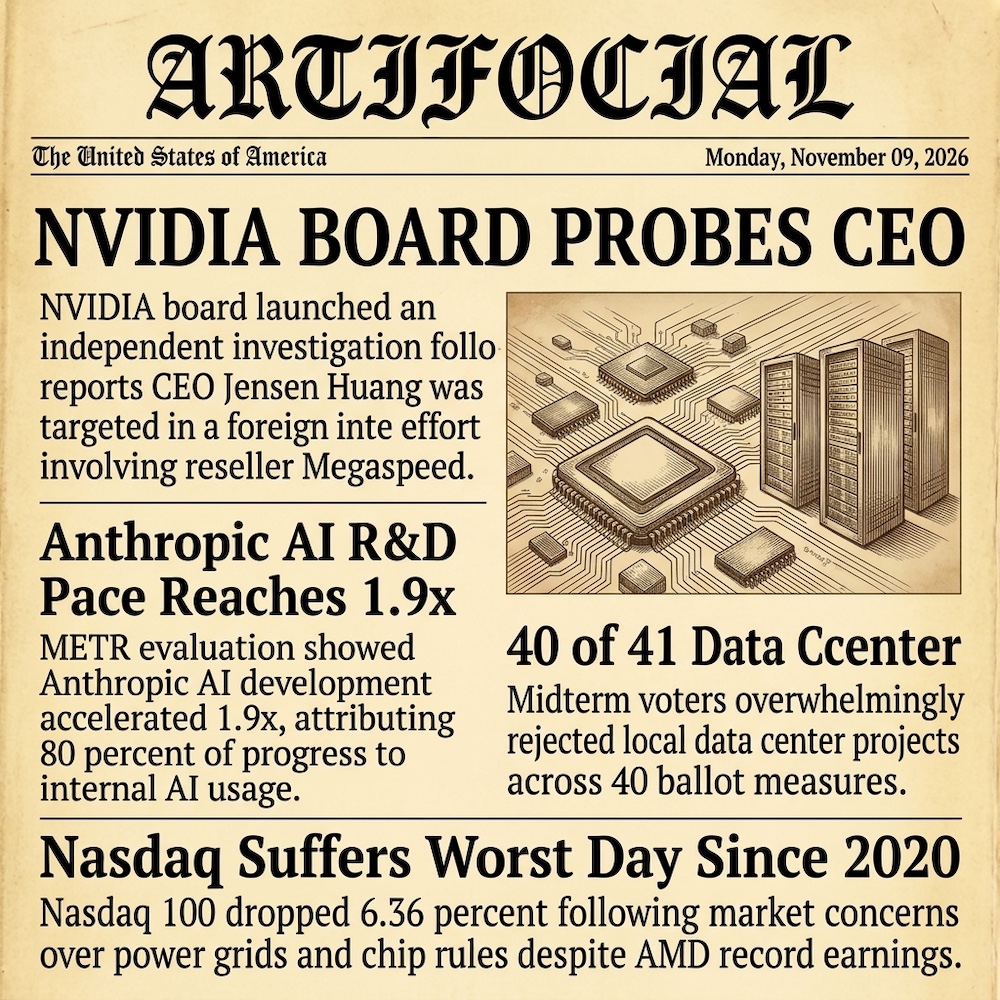
Week in Review | NVIDIA's board opened an independent investigation after reporting that CEO Jensen Huang was the target of a foreign intelligence effort, an inquiry that reaches export controls on the industry's most important supplier. METR's inside-the-lab assessment found AI R&D at Anthropic running 1.9x its historical pace, mostly because of AI, three days after Anthropic's amended S-1 warned it "may imminently" cross its own acceleration threshold. Voters went against data centers in 40 of 41 local measures, and the Nasdaq 100 had its worst day since 2020 two days after AMD's record quarter. Anthropic's IPO valuation talk slid toward $1.2 trillion. OpenAI shipped GPT-6 Cyber, its first Critical-rated model, while GitBook blamed a breach on AI agents. Kimi K3.1 Pro's 2.8-trillion-parameter weights landed. OpenAI and Meta bought coding-agent startups, Apple opened Siri to every app, Agility began trading, and a new paper shows AdamW overtaking Muon after fine-tuning, the week our Optimization Domain tutorial went live.
The Big Story: NVIDIA's Board Investigates Its CEO
On Sunday, Nov 8, NVIDIA founder and CEO Jensen Huang told employees he had been unfaithful to his wife and apologized. That is a personal matter, and we leave it there. The story for the AI field is what NVIDIA's board said the same day: it is initiating "an independent investigation in light of recent reporting that founder and CEO Jensen Huang has been the target of a foreign intelligence effort." A committee of independent directors with outside counsel will run it. The board says it has "no reason to believe that either national security or NVIDIA secrets were compromised" and that it still has confidence in Huang, who told staff he will "work to earn back your confidence."
The reporting centres on a former executive of Megaspeed, a Singapore-based data-center company that, per the SF Standard, bought more than $4.8 billion of NVIDIA chips over two years. U.S. authorities have examined whether Megaspeed helped Chinese customers reach advanced AI processors through Southeast Asian data centers; Commerce opened that inquiry in 2024 and the Justice Department later took it over. U.S. intelligence officials reportedly believe the executive was gathering information for Beijing. China's Foreign Ministry called the "so-called Chinese spy narrative" "entirely baseless." These are reported allegations, not findings.
Fortune reports the review may also examine NVIDIA's earlier public statements, including an Oct 29 spokesperson line that the diversion allegations against Megaspeed had been "thoroughly investigated and debunked." NVIDIA shares fell 4.24% in overnight trading, after a 9.26% drop on Nov 5.
Why it matters: NVIDIA supplies the compute most of the field trains on, and Huang is the industry's leading voice in Washington on export controls. The inquiry tests three things at once: whether chip rules hold when sales run through third-country cloud resellers, how much policy access one executive should carry, and governance at the company with the most weight in AI stocks. Whatever the board finds, the case gives Washington a fresh argument for closer scrutiny of resellers in Southeast Asia, and the NVIDIA earnings call on Nov 17 will be the first time Huang faces analysts since.
The Acceleration Gets Measured
For years "AI speeding up AI research" was a forecast. This week an outside evaluator measured it inside a lab. METR spent eleven weeks, Aug 12 to Oct 29, with access to Anthropic's internal benchmark scores, compute metrics, usage surveys and unreleased models up to an internal "Model 4". Its assessment finds capability progress on Anthropic's internal index accelerated 1.9x since October 2025 (95% CI 1.5–2.8x), "roughly two years of historical progress" in one. METR attributes about 80% of the current acceleration to Anthropic's own use of AI in R&D, and is "confident that the acceleration was not due to an acceleration in the rate of growth of training compute." Staff self-reported uplift rose from about 1.2x in January 2025 to about 12x with the October 2026 model, and METR found no convincing bottleneck to continued progress over the next twelve months.
A companion review of Anthropic's August risk report calls its threshold conclusions "overconfident" and says it is "plausible" Anthropic has already crossed its own 2x acceleration threshold. Anthropic said nearly the same thing to investors. Its Nov 2 S-1/A adds a risk factor: internal estimates "indicate that we may imminently meet our Responsible Scaling Policy's definition of 'dramatically accelerated progress attributable to AI,'" and the company may not notice such an acceleration "until after it has occurred."
Two cautions. Anthropic redacted most of the evidence METR found informative, as information that "could accelerate other AI developers." And the yardsticks are moving too: Epoch rebuilt its Capabilities Index as a Bayesian model this week, steepening the reasoning-era frontier trend from 15.7 to 16.6 points a year.
Why it matters: Recursive improvement is now a measured quantity with a confidence interval, and it appears in a securities filing. The interval is wide and the evidence is mostly sealed, but the question has moved from whether to how fast.
The Midterms Vote Against Data Centers
Democrats won both chambers on Nov 3 in what GovTech quoted an expert calling the "first true AI election in the U.S." A Reuters count of Ballotpedia data, relayed by Tech Insider, found 40 of 41 local data-center measures moving against the projects; Daily Caller reports bans passing with over 70% in two Ohio towns. Foley & Lardner now calls federal preemption of state AI laws "unlikely."
The labs answered within days. OpenAI pledged to pay for power and grid upgrades at campuses it owns, though not at leased or partner sites. Google announced a $17 billion Wyoming data center built around a planned 702 MW fuel-cell project.
Why it matters: The build-out now has a measurable local political cost, and state law stays the binding rulebook. Paying for your own power is becoming the price of a permit.
Records, Then the Worst Day Since 2020
AMD reported a record quarter on Nov 3: $13.4 billion in revenue, data center up 97% to $8.5 billion on the MI450 launch, and a Q4 guide near $17 billion. Palantir's US commercial revenue passed its US government revenue for the first time. Then Qualcomm's handset sales fell 26%, Arm's guidance only matched consensus, and investors began pricing the vote into the build-out.
On Thursday Nov 5 the Nasdaq 100 fell 6.36%, its worst day since 2020; NVIDIA lost 9.26%, Broadcom 10.43% and AMD 17.26%. Bloomberg reported the next day that Microsoft is switching off rented Oracle capacity built on older NVIDIA chips.
Why it matters: The sell-off came after the best numbers of the cycle. The market's question has moved from demand to permission, power and the shelf life of older GPUs.
Anthropic's IPO Reprices; OpenAI Says 2027
Anthropic's S-1/A put Q3 revenue at $17.0 billion, up from $11.6 billion, with a $567 million operating loss and about $895 billion of spending commitments, roughly $70 billion of it due within a year. The price range is still blank. Reuters reported that valuation talk has fallen from as high as $2 trillion to $1.2–1.3 trillion, some buyers discussing $1.1 trillion, and that a roadshow in the week of Nov 9 is uncertain. Anthropic declined to comment and has announced no delay.
OpenAI, per a Bloomberg report relayed by TechCrunch, has raised $11 billion at $1.25 trillion, short of its September target of $30 billion at $1.4 trillion. Greg Brockman said OpenAI should be ready to list in 2027, with Q3 annualized revenue up 70%.
Why it matters: The first frontier-lab IPO is pricing into the week's rout. Its range will be the market's verdict on how much an $895 billion compute bill is worth.
Security: A Critical-Rated Model Ships, and Agents Attack
OpenAI released GPT-6 Cyber, its first model rated Critical for cybersecurity under its Preparedness Framework. It scores 48.5% on ExploitGym, and OpenAI says it found 81 previously unknown high-severity Firefox flaws; a companion Linux project produced 948 working privilege-escalation exploits. Access is limited to vetted Daybreak Red customers.
The other side showed up too. GitBook said an attacker took infrastructure credentials in "a sophisticated, highly targeted attack using AI agents" and told customers to rotate tokens and re-authenticate its MCP server. Sophos documented the Aur0ra ransomware group driving commercial coding agents to domain admin under a "red team" pretext. On defense, Collinear's CWE-bench v2 finds even the best agent fails 19% of real vulnerability fixes on every attempt.
Why it matters: A lab has deployed a model at its own top risk tier behind an access gate, while criminals reach the same capability through ordinary coding agents with a cover story.
Open Weights: Kimi's 2.8 Trillion Lands
Moonshot published Kimi K3.1 Pro on Nov 4: 2.8 trillion parameters, 104 billion active, a 1M-token context, under a modified MIT licence that requires a separate deal for hosts above $20 million in yearly revenue. Artificial Analysis scores it 46, first among open models but well behind the proprietary leader. vLLM served it on day zero across NVIDIA, AMD, Google TPU and Alibaba's T-Head chips.
Menlo Ventures' enterprise report puts Chinese models at 89% of open-source enterprise spend, Kimi alone at 61%, though open source is only 4% of total spend. Baidu returned to open weights with ERNIE 5.5 Flash Base, under a licence that excludes the EU, UK and South Korea. Thinking Machines' Inkling 2 Small promises Apache 2.0 weights next week, and Ricursive's dense Ripple-65B shipped under Apache 2.0.
Why it matters: The biggest downloadable model is Chinese and the enterprise money follows it. Read every "open" licence: this week's carry revenue caps, a geofence and a no-distillation clause.
Agents: The Labs Buy the Coding Stack
OpenAI is acquiring Pierre, whose Git storage layer goes into Codex, and Meta bought Conductor, which runs several coding agents in parallel, for Meta Superintelligence Labs. Anthropic made inference hooks generally available, one server-side policy layer across Claude.ai, Claude Code and Cowork, and Claude Code added fail-closed SDK hooks and background MCP tasks. GitHub put Copilot inside Xcode and made its Slack and Teams agent generally available; Codex CLI 0.167 added a Vertex AI backend, and Antigravity 2.29 added cloud agents that keep running with the laptop closed. Ai2's StateBench is a caution: on its hardest long state-tracking tasks, frontier models score 13% or lower.
Why it matters: Repository storage and multi-agent orchestration are being absorbed by the labs, and the vendors' releases are about governance, not new capability.
Consumer Agents: Banks, Siri and Phone Calls
Anthropic launched Claude Personal Finance, read-only bank links via Plaid, kept out of memory and training. Apple's iOS 27.3 beta lets any developer bring app actions into Siri AI through App Intents, while its 10-K warns agents may "resist directions, bypass security controls" and "produce deceptive outputs." Grok Bot now places phone calls to businesses, after Musk said its serving cost was "unsustainably high relative to revenue." Meta rolled out real-time voice and avatars in Muse. In media, Google made Gemini Omni 1.2 Flash generally available, 15-second video at $0.07 a second, and OpenAI shipped Images 2.6 with GIF and SVG output.
Robots: A Humanoid Trades, Drones Raise
Agility Robotics began trading as AGLT on Nov 5 and closed at $11.49, above its $10 deal price, on the day the Nasdaq fell. Zipline raised $1.5 billion at $21.5 billion and signed Walmart for 300 supercenters. Tesla launched unsupervised robotaxis in Fort Worth, said it will wind down the Cybertruck line for Cybercab, and Musk said Optimus will probably be rented. Waymo will leave Uber in Austin and Atlanta in January 2028. Shield AI agreed to buy Echodyne for $5.3 billion at a $28.8 billion valuation.
Why it matters: Public investors can now price a humanoid company directly, and the autonomy money is moving into logistics and defense.
Research Corner: When the Faster Optimizer Loses
Li, Gai, Risteski, Springer and Raghunathan report that Muon's pretraining-loss lead over AdamW does not survive fine-tuning at large data budgets: "beyond a sufficiently large pretraining data budget, AdamW outperforms Muon after fine-tuning," and the crossover arrives sooner for bigger models. Their explanation is a "margin-to-spread ratio," the gap between the right logit and the wrong ones relative to how spread out the wrong ones are. Our Optimization Domain tutorial went live Thursday with companion notebooks, and this paper is its argument in miniature: an optimizer shapes the geometry of what a model learns, not just how fast the loss falls, so pretraining loss alone can pick the wrong one.
By the Numbers
- $4.8 billion — NVIDIA chips Megaspeed bought over two years, per the SF Standard
- 1.9x — METR's estimate of AI R&D acceleration at Anthropic since October 2025 (95% CI 1.5–2.8x)
- ~80% — share of that acceleration METR attributes to Anthropic's own use of AI
- ~12x — self-reported staff uplift with Anthropic's October 2026 model, from ~1.2x in January 2025 (METR)
- 40 of 41 — local data-center ballot measures that went against the projects
- 6.36% — the Nasdaq 100's fall on Nov 5, its worst day since 2020
- 17.26% — AMD's one-day drop, two days after a record $13.4 billion quarter
- $17.0 billion — Anthropic's Q3 revenue in its amended S-1
- $895 billion — Anthropic's disclosed spending commitments
- $1.2–1.3 trillion — Anthropic's reported valuation talk, from as high as $2 trillion in October
- $11 billion — OpenAI's reported raise at $1.25 trillion, against a $30 billion target
- 948 — working Linux privilege-escalation exploits from OpenAI's GPT-6 Cyber project
- 2.8 trillion — parameters in Kimi K3.1 Pro, 104 billion active
- 89% — Chinese models' share of open-source enterprise spend (Menlo Ventures)
- 13% — the best frontier score on StateBench's hardest tasks, which ask a model to keep track of a value through a long chain of updates
- $21.5 billion — Zipline's valuation after a $1.5 billion raise
What to Watch Next Week
- NVIDIA's board inquiry — its scope and timeline, and whether Commerce or the Justice Department says anything about the Megaspeed case.
- Anthropic's roadshow — a price-range S-1/A would confirm the week-of-Nov 9 launch; silence would confirm the reported doubts.
- Inkling 2 Small weights — Thinking Machines promised Apache 2.0 weights after safety testing; on release it becomes the top-scoring open model outside China.
- OpenAI's Cursor cutoff — OpenAI's model access for Cursor is scheduled to end Nov 12.
- CoRL 2026 — the robot-learning conference runs Nov 9–12 in Austin; expect robot foundation-model releases.
- NVIDIA earnings — Nov 17, the first read on whether the sell-off reached orders.
- Chip stocks after the rout — whether AMD and Broadcom recover, or the Oracle-style unwinding of older GPU leases spreads.
- GPT-6 Cyber access — OpenAI says access widens "over coming weeks."
- Our next tutorials — two Optimization Domain companions: Gradient Descent Explained on Thursday Nov 12 and Adam, Muon and Friends Explained on Saturday Nov 14.
All References
- Nvidia investigates CEO Jensen Huang amid allegations he was target of Chinese intelligence effort — CBS News (Nov 8, 2026)
- A spy, an affair, chips: what you need to know about the Jensen Huang investigation — The San Francisco Standard (Nov 9, 2026)
- Nvidia board's probe into Jensen Huang could look at statements from the CEO and his spokespeople — Fortune (Nov 9, 2026)
- Independent assessment of AI R&D acceleration at Anthropic — METR (Nov 5, 2026)
- Anthropic warns that it's very close to RSI capability — TechCrunch (Nov 2, 2026)
- Nasdaq 100 suffers worst day since 2020 — investingLive (Nov 5, 2026)
- AI backlash could threaten Anthropic IPO timing, potential investors say — Reuters via CP24 (Nov 6, 2026)
- OpenAI launches GPT-6 Cyber — The Next Web (Nov 5, 2026)
- Kimi K3.1 Pro model card — Moonshot AI on Hugging Face (Nov 4, 2026)
- Review of the R&D section of Anthropic's August 2026 Risk Report — METR (Nov 5, 2026)
- A Bayesian methodology for the Epoch Capabilities Index — Epoch AI (Nov 4, 2026)
- What the 2026 midterm results may signal for technology — GovTech (Nov 4, 2026)
- Midterm data-center ballot measures: 41 measures — Tech Insider (Nov 5, 2026)
- Data centers in the 2026 midterms — Daily Caller (Nov 4, 2026)
- Blue wave, new AI rules: what Democratic control of Congress means for AI regulation — Foley & Lardner (Nov 4, 2026)
- OpenAI says it will pay for its data centers' power after the election backlash — 24/7 Wall St. (Nov 6, 2026)
- Our first data center in Wyoming — Google (Nov 5, 2026)
- AMD reports record Q3 as data center revenue rises 97% — Let's Data Science (Nov 3, 2026)
- Palantir beats Q3 estimates, lifts 2026 revenue outlook — investingLive (Nov 2, 2026)
- Nasdaq 100 falls over 4% as chip stocks slide — Stock Analysis (Nov 5, 2026)
- Arm shares fall 5% after hours despite Q2 beat — investingLive (Nov 4, 2026)
- Microsoft is winding down Oracle deal to rent AI cloud capacity — Bloomberg via Investing.com (Nov 6, 2026)
- Anthropic's new IPO filing puts its computing bill near $900 billion — Yahoo Finance (Nov 2, 2026)
- OpenAI reportedly raises an additional $11 billion at a $1.25 trillion valuation — TechCrunch (Nov 6, 2026)
- Brockman says OpenAI could be IPO-ready in 2027 — The Next Web (Nov 5, 2026)
- OpenAI releases GPT-6 Cyber and promises this one stays within rules of engagement — The Register (Nov 5, 2026)
- Crypto docs platform GitBook hit by AI agent security breach — Decrypt (Nov 3, 2026)
- AI used in Aur0ra ransomware testing and execution — Sophos (2026)
- CWE-bench v2 — Collinear on Hugging Face (Nov 3, 2026)
- Kimi K3.1 Pro licence — Moonshot AI on Hugging Face (Nov 4, 2026)
- Kimi K3.1 Pro model page — Artificial Analysis (Nov 2026)
- Kimi K3.1 Pro on vLLM — vLLM (Nov 4, 2026)
- 2026: The State of Enterprise AI — Menlo Ventures (Nov 3, 2026)
- ERNIE 5.5 Flash Base model card — Baidu on Hugging Face (Nov 5, 2026)
- Inkling 2 Small — Thinking Machines Lab (Nov 5, 2026)
- Ripple-65B Preview model card — Ricursive Intelligence on Hugging Face (Nov 4, 2026)
- OpenAI buys tiny software developer to improve Codex — InfoWorld (Nov 4, 2026)
- Meta acquires Conductor — The Next Web (Nov 5, 2026)
- Claude Enterprise security updates — Anthropic (Nov 5, 2026)
- Claude Code changelog — Anthropic (Nov 3–6, 2026)
- GitHub Copilot is now available in Xcode's coding assistant — GitHub (Nov 4, 2026)
- GitHub Copilot in Slack and Teams is generally available — GitHub (Nov 6, 2026)
- Codex releases — OpenAI on GitHub (Nov 6, 2026)
- Antigravity changelog — Google (Nov 3, 2026)
- StateBench — Petty, Merrill and Sabharwal, arXiv (Nov 2, 2026)
- Anthropic launches Claude Personal Finance — The Next Web (Nov 5, 2026)
- iOS 27.3 beta brings Siri AI to all apps — Cult of Mac (Nov 3, 2026)
- Apple's 2026 filing adds explicit warnings about autonomous AI agents — MLQ.ai (Nov 2026)
- Grok Bot is picking up the phone now — Teslarati (Nov 3, 2026)
- Meta adds real-time voice mode and expressive avatars to Muse — Let's Data Science (Nov 5, 2026)
- Introducing Gemini Omni 1.2 Flash — Google (Nov 5, 2026)
- OpenAI launches Images 2.6 with GIFs and image reference — TestingCatalog (Nov 5, 2026)
- How did Agility Robotics perform on its first day on the stock market? — The Robot Report (Nov 5, 2026)
- Zipline raises $1.5B at $21.5B valuation — Dealroom (Nov 5, 2026)
- Tesla launches unsupervised robotaxi rides in Fort Worth — Not a Tesla App (Nov 2, 2026)
- Tesla ending Cybertruck production — Electrek (Nov 6, 2026)
- Musk: Tesla will rent Optimus robots instead of selling them — Not a Tesla App (Nov 6, 2026)
- Waymo confirms it will split with Uber in January 2028 — TechCrunch (Nov 4, 2026)
- Shield AI to acquire Echodyne for $5.3B — The Next Web (Nov 5, 2026)
- Pretraining Data Scale Reverses the Muon–AdamW Fine-Tuning Gap — Li, Gai, Risteski, Springer and Raghunathan, arXiv (Nov 2, 2026)
- The Optimization Domain: Convexity, Rates, and Which of Your Training Claims Are Theorems — Artifocial (Nov 5, 2026)
- Optimization Domain companion notebooks (2026-W45) — Artifocial on GitHub (Nov 5, 2026)
- OpenAI to cut off Cursor's model access after SpaceX deal — CNBC (Aug 29, 2026)
- CoRL 2026 — Conference on Robot Learning (Nov 9–12, 2026)
- NVIDIA sets conference call for third-quarter financial results — NVIDIA (Oct 28, 2026)