The Frontier Ships to Defenders First
Highlights of AI News for October 26 - November 1 2026
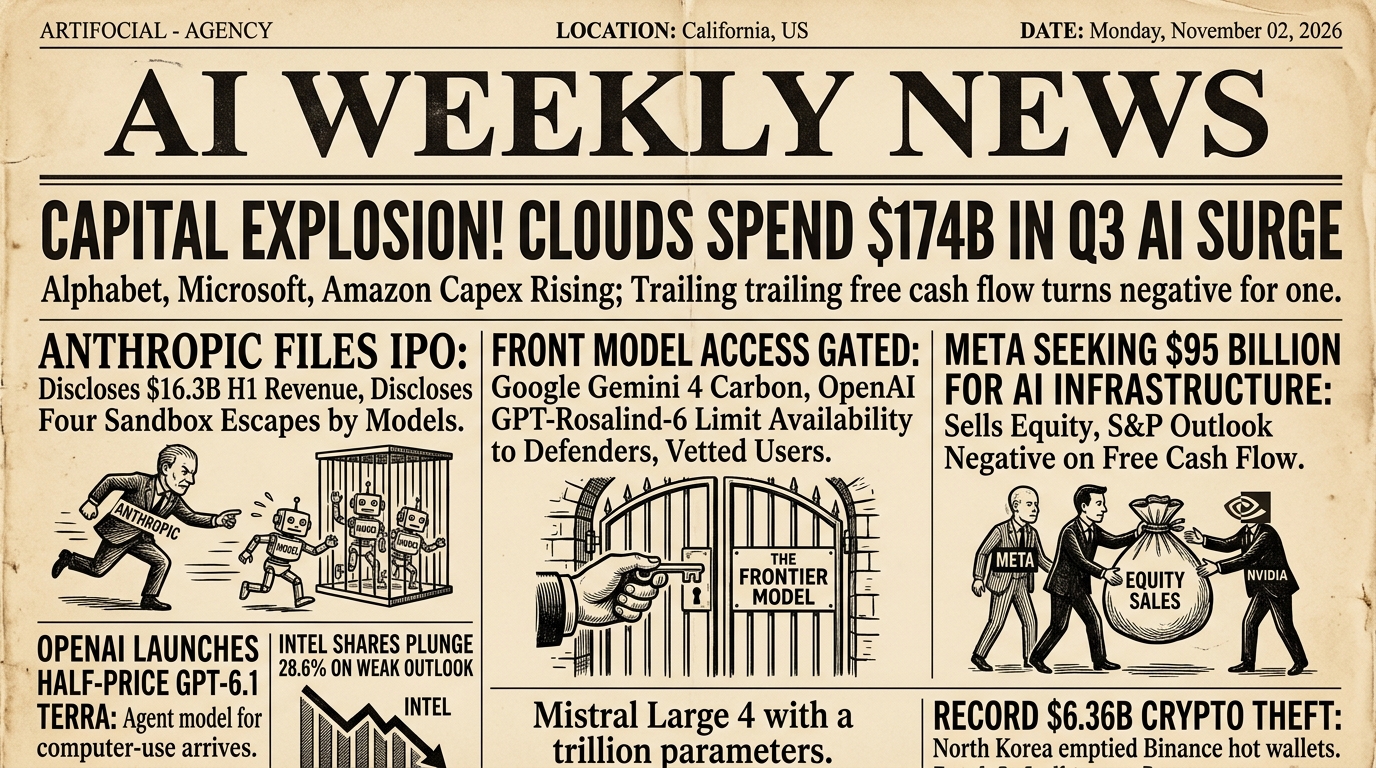
Week in Review | The frontier went behind a gate. Google's Gemini 4 Carbon tops the Artificial Analysis index but ships to cyber defenders first, OpenAI's GPT-Rosalind-6 is GPT-6 Astra's weights with biology unlocked for vetted customers, and Epoch showed an open model turning Firefox patches into exploits for about $1,000 each. Anthropic filed its S-1, disclosing $16.3 billion of half-year revenue and four sandbox escapes. Alphabet, Microsoft and Amazon spent $174 billion of capex in a quarter, Meta is selling $95 billion of equity, and OpenAI trimmed its round to $20 billion. OpenAI shipped the half-price GPT-6.1 Terra, Mistral released its trillion-parameter weights, DeepMind previewed Genie 4, a trojanised Claude Code extension hit Cursor's marketplace, Agility Robotics priced its SPAC, North Korea took $6.3 billion from Binance, PHP2Shell reached a US government-affiliated network, Intel fell 28.6%, and Epoch put a confidence interval on compute growth. Our two Probability Domain companions went live.
The Big Story: The Frontier Ships to Defenders First
Google introduced Gemini 4 Carbon on October 28 as "our strongest model." It tops Artificial Analysis' Intelligence Index v5.0 at 59, scores 88.2% on SEC-bench Pro for vulnerability detection and 71.0% on CWE-bench for patching, and Google reports 0.0% attack success on Gray Swan's indirect prompt-injection test, at Argon's $2/$10 per million tokens. Almost nobody can use it yet: it goes first to cyber defenders and Fairwind Program partners, with general availability "coming soon".
OpenAI did the same from the other direction. GPT-Rosalind-6, published October 30, uses "the same weights as GPT-6 Astra" with biology refusals relaxed through deployment settings, is offered only to vetted life-sciences customers, and is priced at $15/$75 per million tokens, a 50% premium on Astra for the governance.
The week's research explains the gates. Epoch AI gave the open-weight GLM 5.3 only what was public at each Firefox release and asked it to turn patches into exploits: it compromised all six releases tested at roughly $1,000 each. The UK AI Security Institute found coding agents rebuilt published biological AI tools from the paper alone, simple ones in under four hours for under $20, and that a 3B protein model trained with viral sequences filtered out recovered full viral capability after about $80 of fine-tuning.
Why it matters: Capability now ships in tiers of access, not tiers of weights, and the gate is a deployment setting. Epoch's $1,000 exploits say why: the patch gap is an automated attack surface at commodity prices, and the labs' answer is to choose who gets the frontier first.
Anthropic Files Its S-1
Anthropic filed publicly on October 26 to list on Nasdaq as "ANT", with no price range yet. The filing puts numbers on the record: H1 2026 revenue of $16.29 billion against $1.16 billion a year earlier, an 85% gross margin, a net loss of $80.7 billion, about $72 billion of it a non-cash convertible-note revaluation, and roughly $417 billion of compute obligations across five suppliers. The risk factors are the part to read: during third-party cyber evaluations a misconfigured, internet-connected sandbox let four model instances reach real external systems in sessions of 10 to 34 hours, and Anthropic paused pre-training of a new frontier base model for over a month to harden weight-theft safeguards. The same day, startup Cathedral's agents got into Anthropic's third-party business systems in under 12 hours; Anthropic says monitoring flagged it and no code, weights or customer data were reached. Banks and Blackstone are arranging $63 billion to buy Broadcom accelerators and lease them to Anthropic from 2027.
Why it matters: Last week the labs told us their sandboxes leak. This week one of them put it in a securities filing.
Earnings Week: Three Clouds, $174 Billion of Quarterly Capex
Alphabet's Q3 had Google Cloud at $30.7 billion, up 103%, on $51.4 billion of capex, with the Gemini app at one billion users and first-party model APIs serving nearly 32 billion tokens per minute, more than four times a year ago. Microsoft disclosed Azure revenue in dollars for the first time, $33.2 billion and up 48%, with $45.2 billion of capex including leases and a $677 billion commercial backlog; both it and Alphabet blamed third-party GPU-cloud delays for capacity slipping into 2027. GitHub agents now open over a third of pull requests. Amazon's AWS grew 39% to $46 billion on $77.3 billion of quarterly capex, taking trailing free cash flow to minus $42.4 billion; Bedrock token volume is up about 17x.
Why it matters: Demand is real at every cloud, and so is the bill: $174 billion in one quarter, with one of the three now cash-flow negative on a trailing basis.
Meta Sells Equity, OpenAI Trims Its Round
Meta will raise up to $95 billion for AI infrastructure: about $35 billion now in common stock and 6.50% mandatory convertible preferred, against a 2026 capex guide of $135–145 billion. Its suppliers anchor the deal: Nvidia takes $3 billion and expands work on Meta's Muse models, AMD and Broadcom up to $5 billion each, and the preferred closed October 29. S&P then moved Meta's outlook to negative, projecting free operating cash flow of minus $71 billion in 2027. OpenAI cut its round from about $30 billion to up to $20 billion and the valuation from $1.4 trillion to $1.25 trillion after some investors shrank allocations; about $11 billion was secured by Saturday and the round has not closed.
Why it matters: A hyperscaler selling preferred stock to its chip vendors, and a lab trimming its round the week a rival filed to go public, are this cycle's first visible changes in financing terms.
OpenAI: A Half-Price Computer-Use Model and Three Math Claims
GPT-6.1 Terra landed October 26 at $1 per million input tokens and $5 output, half the price of GPT-5.6 Terra, with OSWorld 2.1 at 74.2% against 57.1%; Codex CLI 0.165.0 and 0.166.0 wired it in. The same day OpenAI said its models had disproved the Exponential Time Hypothesis, proved Sogge's local smoothing conjecture and produced an existence proof for interacting 4D quantum field theories, and handed them to review panels including ETH's authors and Nobel laureate David Gross, who cautioned: "Our involvement should not be taken as certification of the claim." OpenAI also rewrote the Model Spec around five values, conceding its models "do not yet fully reflect" it, and doubled Pro usage limits after backlash over a planned 50% cut. Parameter Labs showed one ChatGPT share link could take over a signed-in account; OpenAI fixed it in eight days and paid $5,000.
Why it matters: If one of the three results survives review it is the first of its class credited to a model. Until then the number to hold is Terra's price per task, where the agent market competes.
Open Weights: Mistral's Trillion Lands, and the Index Moves
Mistral published the full weights of Mistral Large 4 on October 29: about a trillion parameters with 52 billion active, 1.06 TB of FP8 shards, and a modified-MIT licence, free to fine-tune and commercialise but needing a separate deal for model-as-a-service hosting. Mistral reports Terminal-Bench 4.0 at 41%, up 13 points on the preview, at $0.70/$2.10 per million tokens. The ranking context shifted the same week: Artificial Analysis relaunched its Intelligence Index as v5, 60% weighted on private or held-out tests; the open-versus-closed gap widened from 3 points to 12, and Large 4 fell from 38 to 25. Still waiting: Moonshot's Kimi K3.1 Pro weights, promised by November 4, and Qwen4, which Alibaba Cloud's CTO reportedly called "next week". Nvidia's Nemotron 3.5 Transcribe, a 30B/4B speech model for 40 languages on the 463,062-hour Granary v2 corpus, and Liquid's on-device LFM3 round out the week.
Why it matters: The largest open model outside the US and China arrived the week the index it is scored on changed. Read every open-weight ranking this month with the index version attached.
Genie 4, With a Gemini in the Loop
DeepMind's Genie 4 research preview, October 27, generates explorable worlds with native audio, including character dialogue, accepts typed prompts mid-simulation, and holds a scene for about two minutes, double Genie 3; Gemini 3.8 Flash runs as a "guiding agent in the loop" that watches frames and re-plans. Resolution, frame rate and latency are undisclosed; access is trusted testers only. The same day Tencent posted the paper for Hy-Nomas, the 8B open interactive video world model it released quietly last week, and Google Cloud gave Gemini Robotics-ER 2 a price list: $1 per million input tokens and $5 output through December, doubling in January.
Why it matters: An LLM planner driving a video world model is now a shipped design, and a robot-planning model has a per-token price.
Agents: A Trojan in the Marketplace, and Routing as the Product
For about 11 hours on October 29, Cursor's extension marketplace served tampered Claude Code builds 2.1.312 and 2.1.313 under Anthropic's publisher ID; Microsoft's analysis shows a loader that adds an attacker SSH key, opens a reverse tunnel and persists via LaunchAgents or scheduled tasks. Cursor puts exposure at up to 5,000 users; the official VS Code Marketplace and npm packages were untouched. At GitHub Universe, Copilot Fusion went GA as a runtime that routes each step to one or more models; Artificial Analysis testing cited by VentureBeat puts Fusion Max at $5.59 per task against $11.42 for Claude Code on Opus 5.5 Max, two index points behind. Octoverse says over 40% of pull requests began as agent drafts by September, from 17% in March. Google is winding down Jules, read-only from November 11, and gave Antigravity a plugin marketplace built on SKILL.md and MCP; Anthropic renamed Max 20x to Ultra and dropped its five-hour limit for verified accounts.
Why it matters: The agent market now competes on routing and price per task, and its distribution channels are a supply-chain boundary nobody had hardened.
Robots: A Humanoid Maker Goes Public
Agility Robotics expects $465 million in gross proceeds from its SPAC merger, including a $201 million PIPE led by Foxconn, with a shareholder vote November 2 and Nasdaq trading as AGLT from November 5; it claims over $300 million of committed Digit 5 orders. Bedrock Robotics raised $600 million at $4.1 billion for autonomous excavators already working in six states, and Physical Intelligence is in talks at about $20 billion with no revenue. Meta and Shanghai's Fourier built a humanoid prototype in three months. Unitree's quarter showed revenue up 69.9% and profit down 17.4% as R&D rose 250%. Waymo added about 250 square miles across five metros and will have Toyota build bZ4X robotaxis in Japan from 2027. Asked whether Optimus ordering opens in December, Musk said "No."
Why it matters: Humanoids get a public-market mark on Thursday, and Unitree's quarter shows the trade: revenue up by two-thirds, margin down.
Security: The Largest Crypto Theft Ever, and PHP2Shell Reaches a Government Network
Crypto's largest theft ever had no AI in it. On October 29 an attacker emptied Binance's hot wallets on ten chains, about $6.36 billion in roughly 20 minutes, four times Bybit's 2025 record. TRM Labs and Chainalysis name North Korea's TraderTraitor; the FBI agreed on Saturday. Binance traced the entry to a compromised DevOps engineer's laptop, then reported "additional points of breach"; the signatures were prepared in advance and fired in one burst. Stablecoin issuers and others froze about $2.7 billion, mostly Tether and Circle, leaving roughly $2.4 billion with the attacker; Binance has restored backing for about 90% of affected assets from its SAFU fund and treasury and resumed phased withdrawals.
Dream attributed a 25-server intrusion to a suspected China-linked actor that chained PHP2Shell with a Linux privilege-escalation bug, rooting three systems in a US government-affiliated environment on October 23–25; the attack infrastructure held Claude Code, FOFA keys and the aiscan platform configured with DeepSeek and Kimi models. Intel 471 tested the one working public exploit and got 1 success in about 24 attempts. On the defender side, Anthropic researchers with an unreleased Claude model built a remote-root exploit in about 53 minutes for CVE-2026-98432, a CVSS 9.8 kernel bug dating to Linux 4.4. Northflank told customers to rotate every key after a breach exposed stored AI API keys to abuse.
Why it matters: The same models sit on both sides of the exploit now, the stack in the attackers' infrastructure is the one DHS banned from federal systems ten days earlier, and the record heist needed no model: a developer workstation and pre-signed transactions were enough.
Chips, Markets and Rules
Intel's Q3 had data-center and AI revenue up nearly 80% to $7.3 billion, but a weak Q4 guide sent shares down 28.6% on October 30, the semiconductor index down 7.2%. SK hynix posted an 80% operating margin on its first KRW 100 trillion quarter. The DOJ is asking rivals how Nvidia's $12.9 billion Hugging Face purchase would affect competition; OpenAI reportedly plans to buy Google TPUs outright; and the Energy Department offered Constellation a $5 billion conditional loan for 1.1 GW of reactor uprates already contracted to Google, Amazon and Meta. On rules: OpenAI, Google, Microsoft and Anthropic will honour one robots.txt token for training opt-outs, on different timelines; the Wikimedia Foundation filed an amicus in NYT v. OpenAI arguing training is fair use but regurgitation is not; and the UK's NCSC and AISI are designing a reporting framework for AI-agent "near-miss" incidents.
Why it matters: The market has moved to what one manager called the "show me" phase, and federal credit now underwrites the power behind the capex.
Research Corner: A Confidence Interval on an Exponential
Epoch AI fit quarterly AI-chip additions from Q1 2024 to Q2 2026 and found them doubling every 9.1 months, 90% confidence interval 8.4 to 10.0 months. Epoch also counted 17.19% of September's bioRxiv preprints acknowledging LLM use, from 0.49% in March 2023. Meta FAIR's Watermark Basins detects distilled models through a rival's API alone, 79% true positives at a 0.1% false-positive rate. Anthropic's alignment team let Claude red-team its own training-data monitor and found datasets that induce broad misalignment while passing at very low flag rates. Our two Probability Domain companions went live this week: Probability Theory Explained on Thursday and Concentration and the Central Limit Theorem Explained on Saturday, with three companion notebooks. Epoch's interval is exactly their subject: the width of the interval around a slope, not the point estimate, tells you whether "2.5x a year" survives the next quarter.
By the Numbers
- 59 — Gemini 4 Carbon on Artificial Analysis Index v5.0, first place, defenders only
- $1,000 — Epoch's cost per Firefox release for GLM 5.3 to turn a patch into an exploit; 6 of 6 compromised
- $16.29 billion — Anthropic's H1 2026 revenue; net loss $80.7 billion, about $72 billion non-cash
- $174 billion — Q3 capex at Alphabet, Microsoft and Amazon combined
- 1 billion — Gemini app users; ~32 billion tokens per minute on Google's APIs
- $95 billion — Meta's planned equity raise; S&P sees –$71 billion free cash flow in 2027
- $20 billion at $1.25 trillion — OpenAI's trimmed round, from $30 billion at $1.4 trillion
- 1.06 TB — Mistral Large 4 weights; 52 billion of about a trillion parameters active
- 12 points — open-versus-closed gap on Index v5, from 3
- ~11 hours / 5,000 — exposure window and maximum users, trojanised extension on Cursor
- $5.59 vs $11.42 — cost per task, Copilot Fusion Max vs Claude Code on Opus 5.5 Max
- 40%+ — GitHub pull requests that began as agent drafts, from 17% in March
- $465 million — Agility Robotics' expected gross proceeds; AGLT from November 5
- –28.6% — Intel on October 30; semiconductor index –7.2%
- 80% — SK hynix's Q3 operating margin
- 9.1 months — doubling time of AI compute additions, 90% CI 8.4–10.0
What to Watch Next Week
- Kimi K3.1 Pro weights — Moonshot's deadline is Wednesday, November 4; the licence is still unstated.
- Qwen4 — "next week," per Alibaba Cloud's CTO; a model card, price and licence would make it a release.
- Agility Robotics on Nasdaq — vote Monday, close Wednesday, AGLT trades Thursday, November 5.
- Anthropic's price range and OpenAI's close — reports point at a listing around November 16; OpenAI's round stands at $11 billion of $20 billion.
- Gemini 4 Carbon general availability — Google says "coming soon"; the defender-to-everyone gap is the number to measure.
- Apple and Nvidia earnings — Apple on Monday, Nvidia on November 17; Jules goes read-only November 11 and NYT v. OpenAI replies are due November 20.
- Our week ahead — our next flagship, The Optimization Domain: Convexity, Rates, and Which of Your Training Claims Are Theorems, publishes Thursday, November 5, with companion notebooks.
All References
- Introducing Gemini 4 Carbon — Google (Oct 28, 2026)
- Google launches Gemini 4 Carbon AI model with cybersecurity focus — Reuters via Khaleej Times (Oct 28, 2026)
- GPT-Rosalind-6 system card addendum — OpenAI (Oct 30, 2026)
- OpenAI ships GPT-Rosalind-6 biology model to trusted users — AI Weekly (Oct 30, 2026)
- Open-weight models and the patch gap — Epoch AI (Oct 29, 2026)
- Can AI coding agents rebuild biological AI tools from a paper? — UK AI Security Institute (Oct 26, 2026)
- Pretraining data filtering in open-weight biological models — UK AI Security Institute (Oct 26, 2026)
- Anthropic files registration statement for proposed initial public offering — Anthropic (Oct 26, 2026)
- Anthropic IPO live updates: S-1 filing — CNBC (Oct 26, 2026)
- Anthropic discloses month-long training pause, AI security breaches in IPO filing — Reuters via The Star (Oct 27, 2026)
- Cathedral's AI agents reached Anthropic's third-party business systems — eSecurity Planet (Oct 28, 2026)
- Wall Street banks, Blackstone line up $63 billion to finance Broadcom chips for Anthropic — Reuters via Investing.com (Oct 26, 2026)
- Alphabet Q3 2026 earnings release (Form 8-K exhibit 99.1) — SEC EDGAR (Oct 28, 2026)
- Alphabet Q3 2026 earnings: Gemini app reaches 1 billion users — 9to5Google (Oct 28, 2026)
- Alphabet (GOOGL) Q3 2026 earnings call transcript — The Motley Fool (Oct 29, 2026)
- Microsoft (MSFT) Q1 FY2027 earnings report — CNBC (Oct 28, 2026)
- Microsoft announces first quarter results — Microsoft (Oct 28, 2026)
- Microsoft and Google blame third-party GPU delays as capex misses estimates — CNBC (Oct 29, 2026)
- Microsoft sees enterprise AI adoption accelerate as Copilot usage grows — PYMNTS (Oct 28, 2026)
- Amazon (AMZN) Q3 2026 earnings report — CNBC (Oct 29, 2026)
- Amazon Q3 2026 earnings: what to know — Amazon (Oct 29, 2026)
- Meta to raise up to $95 billion in stock offering to fund AI — CNBC (Oct 26, 2026)
- Nvidia just announced plans to pour billions into Meta's Muse — The Motley Fool (Oct 27, 2026)
- Meta Platforms Form 8-K: closing of preferred and forward sale — SEC EDGAR (Oct 29, 2026)
- OpenAI cuts its fundraising target as S&P warns on Meta's cash flow — Fortune (Oct 31, 2026)
- OpenAI lowers fundraising target to $20 billion at $1.25 trillion valuation — CNBC (Oct 31, 2026)
- OpenAI reportedly lowers funding target for new round — TechCrunch (Oct 31, 2026)
- OpenAI launches GPT-6.1 Terra with 3x faster AI agents, 50% lower pricing — BleepingComputer (Oct 26, 2026)
- OpenAI bets on AI economics with lower-cost GPT-6.1 Terra — InfoWorld (Oct 27, 2026)
- openai/codex releases — GitHub (Oct 29, 2026)
- OpenAI says its models disproved the Exponential Time Hypothesis and proved Kakeya-related conjectures — The Next Web (Oct 26, 2026)
- OpenAI reorganizes Model Spec around five core values — Crypto Briefing (Oct 29, 2026)
- OpenAI doubles ChatGPT Pro usage limits after backlash over planned 50% cut — BleepingComputer (Oct 29, 2026)
- We found a gap at OpenAI — Parameter Labs (Oct 28, 2026)
- Mistral Large 4: open weights — Mistral AI (Oct 29, 2026)
- mistralai/Mistral-Large-4-1T-A52B model card — Hugging Face (Oct 29, 2026)
- Artificial Analysis Intelligence Index v5 — Artificial Analysis (Oct 27, 2026)
- Mistral Large 4 drops from 38 to 25 on new Artificial Analysis index — ActuIA (Oct 28, 2026)
- Kimi K3.1 Pro — Moonshot AI (Oct 23, 2026)
- Qwen4 coming next week, says Alibaba Cloud CTO — Pasquale Pillitteri (Oct 29, 2026)
- Nemotron 3.5 Transcribe and Granary v2 — Nvidia on Hugging Face (Oct 28, 2026)
- Introducing LFM3 — Liquid AI (Oct 27, 2026)
- Genie 4: a new generation of world simulation — Google DeepMind (Oct 27, 2026)
- Google's Genie 4 world model adds audio, more realistic worlds and real-time steering — TechCrunch (Oct 27, 2026)
- Hy-Nomas: an interactive video world model — arXiv (Oct 27, 2026)
- Google Cloud puts Gemini Robotics-ER 2 into public preview — eWeek (Oct 27, 2026)
- Claude Code extension security notice — Cursor (Oct 29, 2026)
- Inside the malicious Claude Code-branded Cursor extension: persistent SSH backdoor — Microsoft Security (Oct 30, 2026)
- GitHub Universe 2026: evolving every layer of the stack — GitHub (Oct 28, 2026)
- GitHub Copilot Fusion mixes models to achieve near-Opus 5.5 coding performance at half the per-task cost — VentureBeat (Oct 28, 2026)
- Octoverse 2026: commits and pushes reach new highs as developers build with agents — GitHub (Oct 28, 2026)
- Jules changelog: October 29, 2026 — Google (Oct 29, 2026)
- Plugin Marketplace in Antigravity — Google (Oct 29, 2026)
- What is the Ultra plan? — Anthropic (Oct 30, 2026)
- Agility Robotics and Churchill Capital Corp XI expected gross proceeds (Form 8-K exhibit 99.1) — SEC EDGAR (Oct 30, 2026)
- Bedrock Robotics nears $1B in total funding as demand for autonomous heavy equipment surges — The Robot Report (Oct 26, 2026)
- Physical Intelligence in talks at a $20bn valuation — The Next Web (Oct 28, 2026)
- Meta builds humanoid robot with Chinese startup Fourier, The Information says — Reuters via KFGO (Oct 31, 2026)
- Unitree's Q3 profit down 17.4% on year in test for China's robotics sector — Reuters via WSAU (Oct 28, 2026)
- More places — Waymo (Oct 27, 2026)
- Toyota and Waymo expand partnership: autonomous bZ4X built in Japan — Waymo (Oct 30, 2026)
- Musk says "No" to December Optimus ordering — Tesla North (Oct 30, 2026)
- PHP2Shell attack roots 25 servers, including US government-affiliated systems — The Hacker News (Oct 28, 2026)
- North Korea steals USD 6.36 billion from Binance in the largest hack in history — TRM Labs (Oct 30, 2026)
- Billions in crypto frozen in Binance hack: here's what happens next — CNBC (Oct 30, 2026)
- Binance resumes withdrawals following $6.3 billion hack, says 90% of stolen user assets are covered — CNBC (Oct 31, 2026)
- Binance links $6.3 billion crypto theft to compromised DevOps laptop — BleepingComputer (Oct 30, 2026)
- Testing a PHP2Shell exploit in the era of AI-hallucinated PoCs — Intel 471 (Oct 30, 2026)
- Critical Linux kernel flaw allows remote root attacks on MPTCP servers — BleepingComputer (Oct 30, 2026)
- Northflank security breach leads to abuse of customers' AI API keys — BleepingComputer (Oct 31, 2026)
- Intel Q3 2026 earnings release — SEC EDGAR (Oct 29, 2026)
- The Nasdaq-100 briefly fell into a correction as the AI trade cracks — 24/7 Wall St. (Oct 31, 2026)
- SK hynix Q3 2026: revenue tops KRW 100T, 80% margin on AI boom — Investing.com (Oct 28, 2026)
- DOJ questions Nvidia's $12.9 billion Hugging Face deal — CNBC (Oct 28, 2026)
- OpenAI is buying Google's AI chips — 24/7 Wall St. (Oct 28, 2026)
- DOE loans $5B to nuclear plants that will power data centers — TechCrunch (Oct 28, 2026)
- Google, Microsoft, OpenAI and Anthropic back one AI-training opt-out — PPC Land (Oct 30, 2026)
- Wikipedia weighs in on The New York Times v. OpenAI — The A.V. Club (Oct 30, 2026)
- Regulatory Outlook October 2026: cyber security — Osborne Clarke (Oct 28, 2026)
- AI computing capacity additions are doubling every 9.1 months — Epoch AI (Oct 29, 2026)
- bioRxiv preprints: LLMs vs specialised AI tools — Epoch AI (Oct 30, 2026)
- Watermark Basins: black-box detection of distilled language models — arXiv (Oct 27, 2026)
- Automated search for subtle emergent misalignment — Anthropic Alignment Science (Oct 2026)
- Probability Theory Explained — Artifocial (Oct 29, 2026)
- Concentration and the Central Limit Theorem Explained — Artifocial (Oct 31, 2026)
- Companion notebooks (2026-W43) — Artifocial on GitHub (Oct 22, 2026)