The Open-Weight Frontier Arrives: Moonshot's Kimi K3
Highlights of AI News for July 13 - 19 2026
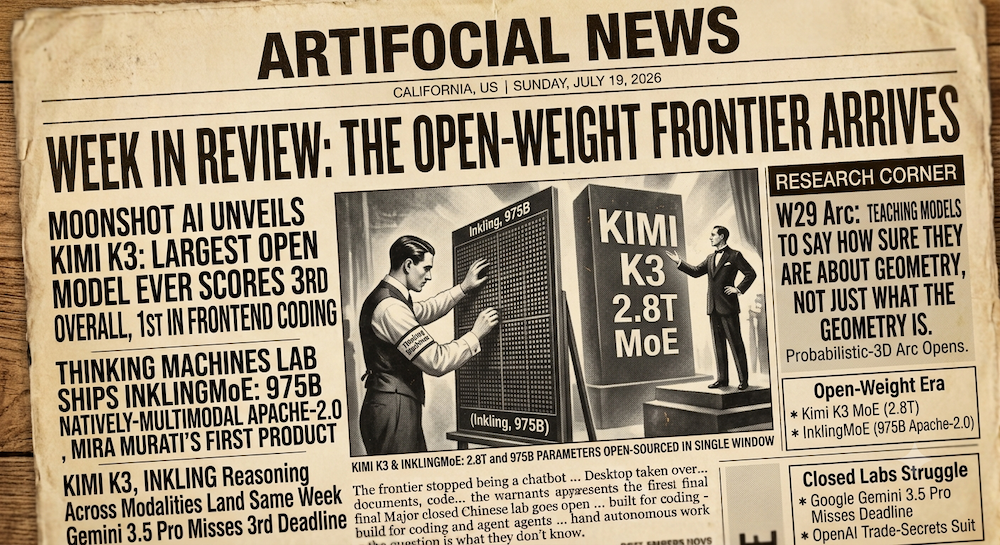
Week in Review | The open-weight frontier arrived in a single 24-hour window: China's Moonshot AI unveiled Kimi K3, a 2.8-trillion-parameter mixture-of-experts model that scores third overall on a leading agentic benchmark and takes first place in frontend coding — the largest open-weight model ever released — while Mira Murati's Thinking Machines Lab shipped Inkling, a 975B natively-multimodal MoE under Apache-2.0, its first product. Both are open, both reason across modalities, and both landed the same week Google's closed Gemini 3.5 Pro missed its third deadline and OpenAI pushed back on Apple's blockbuster trade-secrets suit. And in our own Research Corner, we opened W29's probabilistic-3D arc — teaching models to say how sure they are about geometry, not just what the geometry is.
The Big Story: The Open-Weight Frontier Arrives — Moonshot's Kimi K3
On July 16, Chinese lab Moonshot AI unveiled Kimi K3, which it calls its most capable model to date at 2.8 trillion parameters — roughly 75% larger than DeepSeek's V4-Pro and, by a wide margin, the largest open-weight model anyone has announced. Like every model at this scale it is a sparse mixture-of-experts: VentureBeat reports it routes each token through just 16 of 896 experts, so only a fraction of those 2.8T weights fire per request. It ships with a 1-million-token context window, native visual understanding, an always-on "thinking mode," and two architectural bets Moonshot leans on — Kimi Delta Attention (a hybrid linear-attention mechanism) and Attention Residuals.
The numbers are what make it a frontier event rather than another release. On the GDPval-AA v2 agentic benchmark, K3 scored 1,687 — third overall, behind only Claude Fable 5 Max and GPT-5.6 Sol Max and ahead of Claude Opus 4.8, and it took first place in the Frontend Code Arena. Moonshot prices it at roughly $0.30 per million cached input tokens and $15 per million output — a fraction of comparable closed frontier models. The one caveat worth stating plainly: as of July 17 the weights were not yet on Hugging Face. Moonshot has promised an open-weight release "by July 27," so the "open" claim is a commitment, not yet a download. It's also worth heeding Simon Willison's caution that his fun pelican-on-a-bicycle SVG test — on which K3 burned 13,241 reasoning tokens — no longer tracks real capability; judge the model on the agentic benchmarks and, soon, on the released weights.
Why it matters: For eighteen months the story of open weights has been "impressive, but a tier behind." Kimi K3 collapses that gap — an openly-licensed model sitting third on an agentic leaderboard and first in frontend code changes the build-vs-buy calculus for anyone who can host it. Paired with GLM-5.2 and DeepSeek V4 earlier this quarter, it confirms a durable pattern: the open-weight frontier is now set largely out of China, on a release cadence measured in weeks, and it is closing on the closed labs from below.
Murati's Thinking Machines Ships Inkling — and Bets Against One-Size-Fits-All
A day earlier, on July 15, Thinking Machines Lab released Inkling, its first model more than a year after former OpenAI CTO Mira Murati founded the company. Inkling is a 975-billion-parameter MoE that activates about 41 billion per task, trained on 45 trillion tokens of text, image, audio, and video and reasoning natively across all four. Crucially, it is open-weight under Apache-2.0, with full weights on Hugging Face and one-click fine-tuning on Tinker, the lab's customization platform.
The interesting part is the thesis, not the spec sheet. Where most labs chase the single smartest generalist, Thinking Machines is betting that enterprises ultimately care more about a model they can make their own than about the top of a leaderboard — so it hands you the weights and the tooling to specialize them.
Why it matters: Two natively-multimodal, open-weight MoE models from two continents in the same 24 hours is not a coincidence — it's the shape of the market. The competitive axis is shifting from "who has the best closed model" to "who owns the best customizable substrate," and both a well-funded US lab and China's frontier labs are now pushing on the open side of that line at once.
Google's Gemini 3.5 Pro Misses a Third Deadline
The counter-example to the open-weight momentum came from Mountain View. Gemini 3.5 Pro — Google's answer to GPT-5.6 and Grok 4.5 — was targeted for July 17, but the rebuilt model missed its third consecutive deadline, with reporting that Google is now eyeing a stopgap release. After scrapping the original 2.5-Pro base and re-pretraining from scratch, testers flagged reliability gaps — frequent hallucinations, weak mathematical reasoning, and shaky SVG and image generation. Every headline spec still circulating, including the reported July 17 date, a 2-million-token context window and a "Deep Think" reasoning layer, comes from third-party sourcing rather than an official Google model card.
Why it matters: The same week two labs proved you can ship a frontier-class open model, the incumbent with the deepest compute and data moat couldn't ship its closed flagship on schedule. Cadence is becoming its own competitive weapon, and right now the open-weight side is winning it.
Apple v. OpenAI: The Trade-Secrets Fight Escalates
The week's governance story moved fast. Apple's federal suit — filed July 10, alleging OpenAI stole hardware trade secrets "at every level" — drew out its wildest specifics on July 13: that OpenAI hardware chief Tang Tan, a former Apple VP, directed job candidates still at Apple to bring "actual parts" for "show and tell," and that a former employee allegedly walked out with an Apple laptop. On July 14, OpenAI pushed back, saying it is "not aware of any evidence that this complaint has merit" and that it has "no interest in other companies' trade secrets."
Why it matters: As frontier labs move from software into consumer hardware, the talent-mobility norms that Silicon Valley runs on are colliding with trade-secret law. However this suit resolves, it will help set the boundary for how aggressively an AI lab can hire its way into a new form factor.
Research Corner: When the Model Should Say "I'm Not Sure"
The throughline connecting a frontier-class open model to a stumbling closed one is the same question we've been building toward all arc: not can the model produce an answer, but does it know how much to trust it? This week we opened W29's probabilistic-3D beat. Our trend tutorial, When Gaussians Get Uncertain: Probabilistic 3D Reconstruction, reframes 3D reconstruction from fitting a single scene to inferring a posterior over scenes — so the model reports where geometry is well-constrained and where it's guessing, exactly the way last week's Gaussian-process posterior variance grows where data is sparse. The companion primer, Bayesian Rendering Explained, walks the beginner path from distributions over geometry to distributions over pixels. Both ship with runnable notebooks that build the ideas from scratch.
By the Numbers
- 2.8 trillion — total parameters in Moonshot's Kimi K3, the largest open-weight model ever announced (~75% larger than DeepSeek V4-Pro's ~1.6T).
- 16 of 896 — routed experts K3 fires per token; only a fraction of its 2.8T weights activate per request.
- 1,687 — K3's GDPval-AA v2 score, third overall behind Fable 5 Max and GPT-5.6 Sol Max, ahead of Opus 4.8.
- 1,679 — K3's Frontend Code Arena score, good for first place.
- $0.30 / $15 — K3's per-million cached-input / output token pricing.
- July 27 — the date by which Moonshot has promised to release K3's open weights (not yet on Hugging Face as of July 17).
- 975B / 41B — total vs. active parameters in Thinking Machines' Inkling MoE.
- 45 trillion — tokens of text, image, audio, and video Inkling was trained on, reasoning natively across all four.
- Apache-2.0 — Inkling's license; full weights on Hugging Face, fine-tunable on the Tinker platform.
- 3 — consecutive launch deadlines missed by Google's rebuilt Gemini 3.5 Pro.
- 2 million — reported (unconfirmed) context window for Gemini 3.5 Pro, double the 2.5-Pro cap.
- July 10 → 14 — span from Apple filing its trade-secrets suit to OpenAI's public pushback.
- 2 — natively-multimodal, open-weight MoE frontier models (K3, Inkling) released within a single 24-hour window.
What to Watch Next Week
- Kimi K3's weights. The July 27 open-weight drop is the real test — until the checkpoint, repo, and license land on Hugging Face, "open" is a promise. Watch for the technical report alongside it.
- Inkling in the wild. With weights and Tinker live, watch for the first independently-reported enterprise fine-tune — the customization thesis stands or falls on what practitioners actually ship.
- Gemini's stopgap. Does Google ship a trimmed 3.5 Pro to stop the bleeding, or hold for a full release? Either way the delay reframes the closed-vs-open cadence gap.
- The open-weight answer. K3 won't be the last this quarter — expect DeepSeek, Qwen, and Zhipu to respond, and watch whether a US lab beyond Thinking Machines joins the open side.
- Apple v. OpenAI discovery. Early motions will show how much of Apple's "show and tell" narrative survives contact with the docket — and whether other hardware hires get named.
- World models with calibrated uncertainty. The embodied-AI release rate isn't slowing; watch for the first world model that reports how sure it is about a predicted rollout — the 3D analogue of the posterior variance our W29 tutorials build.
- Our week ahead. We continue the probabilistic-3D arc, carrying the uncertainty spine from Gaussian processes into geometry and rendering.
All References
- Kimi K3 — Simon Willison, July 16, 2026: Kimi K3, and what we can still learn from the pelican benchmark; Constellation Research: Moonshot AI launches Kimi K3; VentureBeat: China's Moonshot AI releases Kimi K3, the largest open-source model ever
- Thinking Machines' Inkling — TechCrunch, July 15, 2026: Thinking Machines amps up its bet against one-size-fits-all AI with Inkling; Axios: Mira Murati's Thinking Machines debuts its first AI model; SiliconANGLE: Thinking Machines drops Inkling, an open-weights model anyone can access; Fortune: What is Inkling?
- Gemini 3.5 Pro delay — Enterprise DNA, July 16, 2026: Gemini 3.5 Pro July 17 rebuild; TechTimes: Rebuilt Gemini 3.5 Pro misses third deadline, Google eyes stopgap; ABAB News: Gemini 3.5 Pro targets July 17
- Apple v. OpenAI — CNBC, July 10, 2026: Apple sues OpenAI alleging trade secret theft; TechCrunch, July 13: The wildest allegations in Apple's trade-secrets lawsuit; TechCrunch, July 14: OpenAI pushes back on Apple trade-secret lawsuit
- Open-weight context — Trending Topics, June 2026: GLM-5.2: China's Zhipu AI beats even Google's top models
- W29 trend tutorial: When Gaussians Get Uncertain: Probabilistic 3D Reconstruction
- W29 primer: Bayesian Rendering Explained
- W29 notebooks: github.com/artifocial/tutorials/2026-W29
Build with AI — early access
Watching open weights reach the frontier and wondering how to actually build on them? Build with AI is our early-access program for engineers who want to go from tutorials like these to shipping production AI systems — hands-on guidance instead of guesswork. Early access is opening now.