Frontier Weights Went Public — With a Price Tag Attached
Highlights of AI News for August 10 - 16 2026
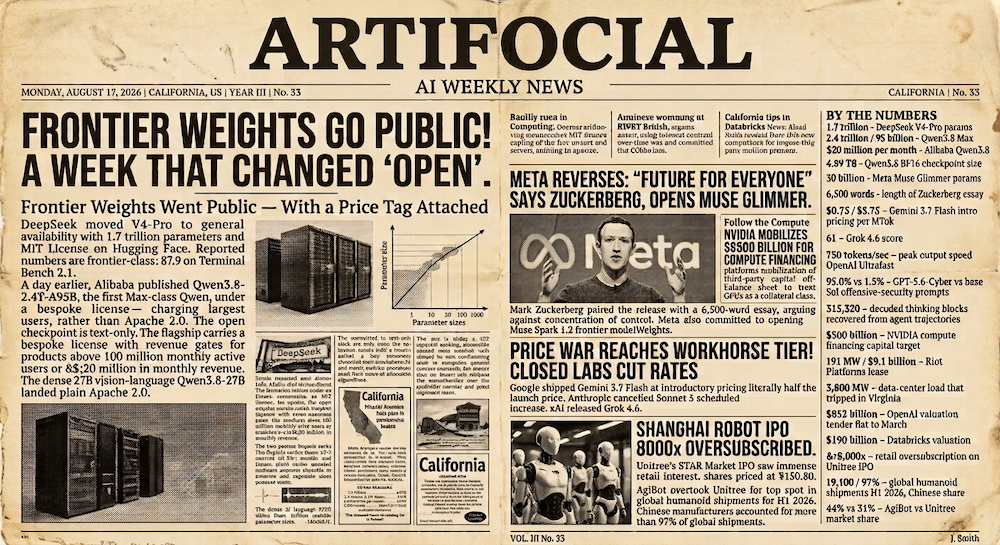
Week in Review | For two years "open weights" meant a tier below the frontier. This week it stopped meaning that. DeepSeek took V4-Pro to general availability — 1.7 trillion parameters, real safetensors, MIT license — and a day earlier Alibaba published Qwen3.8-2.4T-A95B, the first Max-class Qwen ever released, under a bespoke license that charges the largest users rather than the Apache 2.0 its predecessors shipped with. Meta chose the same week to reverse course entirely, releasing Muse Glimmer under Apache 2.0 and committing to open its frontier model's weights. The closed labs answered on price, not capability: Google's Gemini 3.7 Flash launched at half its predecessor's rate, Anthropic cancelled a scheduled increase on Sonnet 5, and xAI shipped Grok 4.6 into the same bracket. Underneath all of it, Nvidia spent Monday turning GPUs into a $500 billion asset class, and in Shanghai a humanoid-robot maker's IPO was oversubscribed more than 8,000 times.
The Big Story: Frontier Weights Went Public — With a Price Tag Attached
On August 13, DeepSeek moved V4-Pro-0813 out of preview into general availability, and — critically — put the weights on Hugging Face. The model card carries real safetensors for a 1.7-trillion-parameter model under the MIT License, which is about as permissive as software licensing gets. The reported numbers are frontier-class: 87.9 on Terminal Bench 2.1, 62.7 on DeepSWE, 60.0 on HLE-with-tools, 83.3 on CyberGym and 71.1 on DSBench-FullStack, with up to 384K output tokens across low, high and max thinking-effort settings. DeepSeek's own API changelog says nothing about openness — the weights are the announcement.
A day earlier, Alibaba did something it had never done: it published a Max-class Qwen. Qwen3.8-2.4T-A95B is a 2.4-trillion-parameter fine-grained mixture-of-experts with 95 billion active — 512 experts, ten routed plus one shared per token — with 262,144 tokens of native context extensible past a million. It posts 92.6 on GPQA Diamond, 67.7 on SWE-bench Pro, 86.6 on Terminal Bench 2.1 and 93.0 on PaperBench. The BF16 checkpoint runs to roughly 4.89 TB; an FP8 variant ships alongside. It is also, pointedly, not the hosted product: the open checkpoint is text-only and requires thinking mode, while the API version takes vision input and defaults to a million-token window.
The structural news is the license. Where every prior Qwen generation shipped Apache 2.0, the flagship carries a bespoke Qwen3.8-Max License with revenue gates: products above 100 million monthly active users or $20 million in monthly revenue must display the model name prominently, and model-as-a-service businesses clearing $50 million in group revenue over twelve consecutive months need separate written authorization. That is the first serious attempt by a major Chinese lab to monetize open weights through licensing rather than inference. Notably, Alibaba did not extend the gate downmarket — the dense 27B vision-language Qwen3.8-27B that landed August 14 is plain Apache 2.0, and it is unusually strong for its size: 89.2 GPQA Diamond, 61.7 SWE-bench Pro and 84.3 on OSWorld-Verified, a computer-use score you would not expect from 27 billion parameters.
Nvidia filled the middle of the range on August 11 with Nemotron 3.5 Lightning, a 30B-total / 3B-active hybrid of Mamba-2, MoE and selective attention with a 1M-token context (256K on a single H100), released with weights, data and training recipes under the OpenMDW license. It scores 81.94 MMLU Pro, 75.44 GPQA Diamond and 51.56 SWE-bench Verified, and Nvidia claims up to 4x faster output and 30% faster agentic task completion in its class — though the card itself concedes Gemma 4 26B and Qwen 3.6 35B beat it on several reasoning tasks. Nvidia paired the release with NeMo Switchyard, an open model-routing library it says holds frontier accuracy at roughly a third the cost of running Opus 4.8 alone. The tooling kept up: Hugging Face shipped Transformers v5.15.0 on Monday with day-one architecture support, and vLLM published day-zero support posts for both the Nemotron and Qwen drops within 48 hours of each.
Why it matters: A week ago the frontier-scale open-weight tier had essentially one credible occupant. It now has four, from three countries and two continents, and the checkpoints are downloadable rather than promised. But the same week that expanded access also introduced the mechanism for restricting it — a revenue-gated license on the single most capable open model released. The question for the next quarter is no longer whether open weights can reach the frontier. It is whether "open" survives contact with the business model, and Alibaba has now written down a specific answer: open for everyone below $20 million a month.
Meta Reverses: 30 Billion Parameters, Apache 2.0, and 6,500 Words of Argument
Meta Superintelligence Labs released Muse Glimmer on August 10 — a 30-billion-parameter agentic model under Apache 2.0, structured as a 2B vision encoder feeding a 28B text decoder and distilled from the proprietary Muse Spark teacher. The engineering target is explicitly the single consumer GPU: quantized to roughly 4-bit it fits under 20GB, inside a 24–32GB envelope, and with the DFlash speculative-decoding drafter it runs 3.1x faster on an RTX 5090, 1.8x on an M5-Max and 1.5x on an M4-Max. Meta benchmarks it against Gemma4-31B and Qwen3.6-27B across agentic, coding, multimodal and safety tasks, and it shipped on Hugging Face day one.
The model is the smaller half of the story. Zuckerberg paired it with a roughly 6,500-word essay, The Future Is for Everyone, arguing that the central risk in AI is concentration of control rather than raw capability, and that restricting access to foreign open-source models does not work. Meta also committed to opening the weights of Muse Spark 1.2 — its actual frontier model, launched proprietary five days earlier. That commitment came from Alexandr Wang rather than Zuckerberg, a detail several wires got wrong. Alongside it Meta announced a $1 billion fund for communities near its data centers.
Why it matters: Meta went proprietary with Muse in April 2026 and reversed inside four months. Read charitably, it is a bet that distribution beats margin. Read structurally, it is what happens when a lab looks at the week's DeepSeek and Qwen releases and concludes the open tier is going to exist with or without it. Either way, a Western lab has re-entered a field that had become almost entirely Chinese.
The Price War Reaches the Workhorse Tier
The closed labs did not answer the open-weight flood with capability announcements. They answered with pricing.
Google shipped Gemini 3.7 Flash to general availability on August 13, three weeks after 3.6 Flash, with substantial gains: DeepSWE v1.1 rose from 49.0% to 65.3%, FrontierCode 1.1 Main from 34.4% to 43.6%, AutomationBench from 17.0% to 30.4%, and WebDev Arena Elo from 1538 to 1588. Introductory pricing is $0.75 per million input tokens and $3.75 output through December 31, 2026 — literally half the launch price of 3.6 Flash — reverting to $1.50/$7.50 on New Year's Day. The flagship Gemini 3.5 Pro remains delayed with no ship date.
Anthropic made a quieter move the same week. Its platform release notes state that the introductory $2/$10 per million tokens on Claude Sonnet 5 is now the standard price, and that the increase to $3/$15 scheduled for September 1 will not occur — a permanent 33% discount against a rate the company had already committed to. Anthropic also shipped product: the Claude in Chrome side panel became Claude Cowork on August 12, adding saved history, in-browser skills and connectors, and an intent-matching approval check before consequential actions.
xAI released Grok 4.6 on August 12, aimed at long-running agents, scoring 61 on the Artificial Analysis Intelligence Index — a tie with GPT-5.6 Sol — with 65.9% on DeepSWE v1.1 and 69.9% on CursorBench v3.2, a 500k context window, and tiered pricing that doubles above 200k prompt tokens. Musk's widely-repeated 1.5-trillion-parameter claim does not appear in xAI's own release notes; treat it as unconfirmed. And Z.ai previewed GLM-5.3 on August 14 with an unusual claim: the 743B base is unchanged from GLM-5.2, and every gain — Terminal-Bench 3.0 from 4.6 to 28.3, DeepSWE v1.1 from 46.2 to 66.9 — comes from scaled post-training alone. The weights are not out; Z.ai says roughly two weeks, pending safety hardening.
OpenAI's contribution was speed rather than price. It previewed "Ultrafast" on August 13, an API tier running GPT-5.6 Sol up to 14x faster than Standard at up to 750 output tokens per second on Cerebras hardware, behind a waitlist with no disclosed pricing. Separately, Google announced on August 11 that the Gemini app had crossed 1 billion monthly active users, with 63% of users interacting by voice and more than 150 million images generated daily — though it disclosed no paid-subscriber count, which is the number that would actually settle the price war.
Why it matters: When four labs cut or hold prices in the same week that four frontier-scale open checkpoints hit Hugging Face, those are not independent events. Inference is commoditizing from both directions at once, and the margin is migrating to whoever owns distribution or silicon.
OpenAI Ships a Model Trained Not to Refuse
On August 10 OpenAI introduced GPT-5.6-Cyber, built on GPT-5.6 Sol and deliberately tuned to a lower refusal rate for offensive-security work. Per SecurityWeek, it completes 95.0% of exploit-development, privilege-escalation and authentication-bypass prompts, against 1.5% for GPT-5.6 Sol and 57.3% for GPT-5.5-Cyber. OpenAI says the model found CVE-2026-15903, a high-severity bug in Chrome's V8 engine since reported and fixed, plus flaws in a mobile OS, a database and an OS kernel. Access is gated through an expanded Daybreak program split into Blue and Red tiers, with Accenture, IBM, CrowdStrike, Cloudflare, Palo Alto Networks and Fortinet among the named partners. Both Sol and Cyber are rated "High" on cybersecurity under OpenAI's Preparedness Framework — below the Critical threshold that caused the company to slow its Astra model a week earlier.
A separate result landed August 12 that should trouble anyone running agents on any of the three major APIs. Researchers demonstrated that the encrypted reasoning blocks those APIs return can be replayed into a weaker model to recover hidden chain-of-thought. Across 6,708 public agent trajectories they decoded 315,320 thinking blocks and recovered 704 distinct privacy artifacts from real user sessions — including 62 API keys, 33 passwords, 24 access tokens and 7 private keys — and 64 of those artifacts appeared only in the hidden reasoning, never in visible output (paper; summary). The authors are candid that they lack ground-truth plaintext and cannot guarantee exact reconstruction, but the direction of the finding is clear: an encrypted reasoning trace is obfuscation, not a secret.
Why it matters: These are the same story from opposite ends. One is a lab deliberately removing a safety behavior because defenders need the capability; the other is a demonstration that the opacity labs lean on for safety is thinner than advertised. Both land on the conclusion our own tutorials keep arriving at — that the useful control surface is not what a model knows, but where the system around it is designed to stop.
Follow the Compute
Nvidia opened the week by changing what a GPU is. On August 10 it announced memoranda of understanding with Apollo, BlackRock, Blackstone, Brookfield, Goldman Sachs and KKR to stand up independent compute-financing platforms mobilizing more than $500 billion of third-party capital — off Nvidia's own balance sheet. Jensen Huang's framing was the point: "In AI, compute is revenue… fungible and transferable across customers and operators." That is an argument for treating GPUs as a collateral class. The release is explicit that these are MOUs subject to final agreements, with no per-platform or gigawatt breakdown, and the widely-quoted 25% residual-value backstop comes from Huang's remarks, not the filing. NVDA fell about 3% on the news.
The leases followed the same logic. Riot Platforms disclosed a 191 MW, 20-year lease at Rockdale, Texas worth roughly $9.1 billion, extendable to about $16.1 billion, with 96 MW live in December 2027 and full buildout by June 2028 — reportedly to Anthropic, though Riot never named the tenant. Fermi signed its first binding lease: 222 MW to TensorWave, about $6.5 billion over 15 years, phased from H2 2027. And the grid began to push back — PJM is weighing interconnection reliability standards for data centers after roughly 3,800 MW of load tripped offline in northern Virginia on July 22, the largest such event in its history, with NERC due to finalize criteria by December 31.
The capital markets told the more interesting story through their asymmetries. Anthropic's backers are reportedly targeting an October IPO at $2 trillion or more, against a last private mark of $965 billion; the company is also in talks to acquire chip-efficiency startup Decart AI for about $6 billion. OpenAI, meanwhile, completed a $7 billion employee tender at a flat $852 billion — the same mark as March — while its executive bench kept turning over: longtime COO Brad Lightcap is leaving, and two days later Dali Rajic replaced Denise Dresser as CRO after nine months. OpenAI did land distribution: IBM is embedding GPT-5.6, Codex and ChatGPT Work across IBM Consulting Advantage with a dedicated practice of "thousands of consultants and engineers," though no contract value was disclosed.
Elsewhere in the same five days: Databricks raised $5 billion at $190 billion on a $7 billion run rate, after asking for $1 billion and being offered $15 billion; Intel priced an upsized $20 billion equity offering at $95 a share; Cognition is in talks at $40 billion, up from $26 billion in May; xAI co-founder Igor Babuschkin's two-month-old River AI raised $1.1 billion; SMIC cleared $3 billion in quarterly revenue for the first time; and Sony and TSMC signed a ¥747 billion image-sensor joint venture in Kumamoto.
Robots Went Public — Literally
The most striking number of the week came out of Shanghai. Unitree's STAR Market IPO was oversubscribed more than 8,000 times by retail investors, with a lot-winning rate of roughly 0.018%. Shares priced at ¥150.80, raising about $900 million at a valuation above ¥60 billion — Reuters put the terms at 219 times 2025 earnings. It is the first pure-play humanoid maker to list on a mainland exchange. The shares had not begun trading as of Friday.
The market it is listing into shifted underneath it. H1 2026 global humanoid shipments reached about 19,100 units, up roughly 275% year over year, and AgiBot overtook Unitree for the top spot — about 8,400 units and 44% share against Unitree's 5,900 and 31%. Chinese manufacturers accounted for more than 97% of global shipments, and industrial and commercial deployments rose from roughly half of volume to over 70%, which is the more meaningful signal: these are going to work, not to demos.
Western industry answered through partnership rather than product. LG and NVIDIA signed an MOU on August 13 covering a next-generation bipedal humanoid built on Isaac GR00T, NVIDIA's open humanoid foundation model, with Jetson Thor onboard and NVIDIA Halos as the safety stack, targeting a Q1 2027 unveiling — alongside an 80 MW AI factory in Cheonan by H1 2028. Chinese venture capital kept pace, with three embodied-AI rounds surfacing in early August: $74 million into Noin Intelligence for a world-model-plus-VLA household system, a nine-figure Pre-A into PokeBot for a "World Action Model" trained with real-world reinforcement learning, and $100 million into Discover Robotics.
Why it matters: An open humanoid foundation model is now the substrate for a Korean conglomerate's flagship robot, in the same week open LLM weights went frontier-scale. The pattern holds across modalities: the model layer commoditizes, and the defensible positions move to embodiment, distribution and power.
Research Corner: Our Own Arc Closed This Week, on the Week's Own Question
We shipped two pieces this week, and they close a four-part arc that has been circling one idea since July. The Full Loop: World Models That Act on What They Don't Know is the finale; Planning Under Uncertainty: From MPC to Active Inference builds the machinery from first principles. The arc began by reframing attention as kernel regression, spent a week on probabilistic 3D reconstruction, and then made calibrated confidence the hinge of neuro-symbolic reasoning. A calibrated confidence number, we kept saying, is a permission slip. This week we finally asked what it gives permission to do — and the answer forced us to revise our own thesis on the way out.
The revision is this. Three weeks of argument assumed that if you calibrate a model's uncertainty, you can act on it. Biased Dreams (Berger et al., RLC 2026) shows that ensemble disagreement over a recurrent state-space model captures local epistemic uncertainty but does not reliably track the global error compounding across a long latent rollout — and documents an attractor effect in which rollouts drift toward densely-sampled regions, so uncertainty shrinks precisely as divergence from true dynamics grows. The model gets more confident as it gets more wrong. What works instead, in the 2026 systems that make this pay off, is not better introspection but a conformal bound calibrated against held-out reality: trust relocated out of the model's opinion of itself and into a calibration set you control.
Hold that against this week's news, because three of the biggest stories are the same move at different scales. The reasoning-trace extraction paper is the cleanest case: 315,320 decoded thinking blocks say that a boundary enforced by opacity was never a boundary, only an untested assumption about one. GPT-5.6-Cyber is the same lesson run forward — OpenAI moved the threshold at which the model declines to act, then wrapped the result in Daybreak's Blue and Red access tiers, conceding that the in-model threshold was not the control surface. And the open-weight flood removes the last comfortable assumption behind both: when a 1.7-trillion-parameter checkpoint ships under the MIT License, no limit that lives in the weights survives contact with a fine-tune. Whatever governs use has to sit outside the model.
Our finale ends on a deflating result — Confidence-Gated Robot Autonomy finds that above a competence floor, the choice of uncertainty method matters far less than where you set the threshold. That is a robot-autonomy paper whose evidence base is activity-recognition benchmarks, and we would be overreaching to promote it to a law of the industry. But notice what actually got decided in the last five days. Alibaba drew a line at $20 million in monthly revenue. OpenAI drew one at a partner tier. PJM has begun drawing one at the interconnection. None of those are capability decisions; all of them are threshold decisions — and, exactly as the arc concluded, no posterior makes them for you.
The next arc opens on the question a single agent cannot answer: what happens when the other thing in your environment is also optimizing? Game theory meets deep learning. Last week's full roundup is here.
By the Numbers
- 1.7 trillion — parameters in DeepSeek V4-Pro-0813, released to general availability with weights under the MIT License.
- 2.4 trillion / 95 billion — total and active parameters in Qwen3.8-2.4T-A95B, the first Max-class Qwen released as open weights.
- $20 million per month — the revenue threshold above which Alibaba's new Qwen3.8-Max License imposes attribution obligations; $50 million in group revenue triggers a written-authorization requirement for MaaS providers.
- 4.89 TB — size of the Qwen3.8-2.4T BF16 checkpoint, which is its own kind of access control.
- 30 billion — parameters in Meta's Muse Glimmer, Apache 2.0, running under 20GB at 4-bit on a single consumer GPU.
- 6,500 words — length of Zuckerberg's open-weights manifesto, The Future Is for Everyone, published alongside it.
- $0.75 / $3.75 — Gemini 3.7 Flash introductory pricing per million input/output tokens, half its predecessor's launch rate, through December 31, 2026.
- $3 → $2 per MTok — Anthropic's cancelled September 1 price increase on Claude Sonnet 5 input tokens.
- 61 — Grok 4.6's Artificial Analysis Intelligence Index score, tied with GPT-5.6 Sol.
- 750 tokens per second — peak output speed of OpenAI's previewed Ultrafast tier on Cerebras hardware, up to 14x Standard.
- 95.0% vs 1.5% — GPT-5.6-Cyber's completion rate on offensive-security prompts, against base GPT-5.6 Sol.
- 315,320 — hidden reasoning blocks decoded from 6,708 public agent trajectories, yielding 62 API keys and 33 passwords.
- $500 billion — third-party capital Nvidia's six new financing platforms aim to mobilize for AI compute.
- 191 MW / $9.1 billion — Riot Platforms' 20-year Rockdale lease, extendable to roughly $16.1 billion.
- 3,800 MW — data-center load that tripped offline in northern Virginia on July 22, prompting PJM's reliability review.
- $852 billion — OpenAI's valuation in its completed $7 billion employee tender, flat to March.
- $190 billion — Databricks' new valuation on a $5 billion round, against $15 billion of investor interest.
- >8,000x — retail oversubscription on Unitree's Shanghai IPO; the lot-winning rate was about 0.018%.
- 19,100 / 97% — global humanoid shipments in H1 2026, and the share built by Chinese manufacturers.
- 44% vs 31% — AgiBot's and Unitree's shares of that market, a reversal of last year's ranking.
What to Watch Next Week
- Z.ai's GLM-5.3 weights — promised roughly two weeks out. If they land permissive, the frontier open tier gains a fifth occupant; if they land gated, Alibaba's licensing move looks like a trend rather than an outlier.
- Muse Spark 1.2's weights — Meta committed to opening its frontier model. The license it picks will say more than the manifesto did.
- Whether anyone can actually run 4.89 TB — watch for quantized community re-releases of Qwen3.8-2.4T and the first independent reproductions of its GPQA and SWE-bench Pro numbers.
- Gemini 3.5 Pro — still delayed with no ship date while Flash iterates every three weeks. The gap is becoming a story in itself.
- Nvidia's Q2 FY27 earnings on August 26 — the first read on whether the $500 billion financing structure changes how the company books demand.
- Unitree's first trading day — an 8,000x-plus oversubscription at 219 times earnings sets up either a spectacular debut or a fast lesson in humanoid valuations.
- California's suspense-file survivors — roughly 30 AI bills cleared or died on August 13; the ones that lived face floor votes before the August 31 adjournment.
- Our next flagship — the biweekly cycle resumes with a Lane A piece on building with an agent org. If you want the practitioner version of "the thresholds have to live in the system," that is where it goes.
All References
- DeepSeek-V4-Pro-0813 model card — Hugging Face (Aug 13, 2026)
- DeepSeek API changelog — DeepSeek (Aug 2026)
- Qwen3.8-2.4T-A95B model card — Hugging Face (Aug 12, 2026)
- Qwen3.8-27B model card — Hugging Face (Aug 14, 2026)
- Introducing Muse Glimmer, an open agentic model — Meta AI Research (Aug 10, 2026)
- Zuck rekindles open-weights Llama drama with Muse Glimmer — The Register (Aug 10, 2026)
- Meta releases open-weight Muse Glimmer, to open Muse Spark 1.2 — Constellation Research (Aug 10, 2026)
- NVIDIA Nemotron 3.5 Lightning 30B-A3B model card — Hugging Face (Aug 11, 2026)
- Nemotron Lightning and NeMo Switchyard — NVIDIA (Aug 11, 2026)
- Transformers v5.15.0 release notes — Hugging Face (Aug 10, 2026)
- vLLM blog — day-0 support posts — vLLM Project (Aug 10–14, 2026)
- Introducing Gemini 3.7 Flash — Google (Aug 13, 2026)
- The Gemini app passes one billion monthly users — Google (Aug 11, 2026)
- Claude platform release notes — Anthropic (Aug 10–14, 2026)
- Claude Cowork comes to the Chrome side panel — Anthropic (Aug 12, 2026)
- Grok 4.6 — xAI (Aug 12, 2026)
- Z.ai ships GLM-5.3 without retraining the base model — MarkTechPost (Aug 14, 2026)
- OpenAI previews Ultrafast, GPT-5.6 Sol running up to 14 times faster — 9to5Mac (Aug 13, 2026)
- OpenAI unveils new cybersecurity model GPT-5.6-Cyber — SecurityWeek (Aug 11, 2026)
- As AI-led attacks multiply, OpenAI launches a new cyber model — TechCrunch (Aug 10, 2026)
- Stealing Reasoning Traces from Proprietary LLM APIs — arXiv:2608.09867 (Aug 12, 2026)
- API flaw let researchers recover hidden chain-of-thought — The Hacker News (Aug 12, 2026)
- NVIDIA partners with Apollo, BlackRock, Blackstone, Brookfield, Goldman Sachs and KKR — NVIDIA Newsroom (Aug 10, 2026)
- Nvidia's private capital deal and the circular financing question — Fortune (Aug 12, 2026)
- Riot Platforms surges on $9.1 billion Anthropic deal — CoinDesk (Aug 11, 2026)
- Fermi announces binding lease agreement with TensorWave — Fermi America (Aug 10, 2026)
- PJM weighs data center reliability standards after load loss — Utility Dive (Aug 12, 2026)
- Anthropic eyes $2 trillion in October IPO — Forbes (Aug 13, 2026)
- Anthropic in talks to acquire Decart AI for about $6B — StartupHub (Aug 13, 2026)
- OpenAI completed a $7 billion employee tender offer — TechCrunch (Aug 10, 2026)
- Brad Lightcap, OpenAI's longtime COO, is leaving — TechCrunch (Aug 11, 2026)
- OpenAI hires new CRO as executive shake-up continues — TechCrunch (Aug 13, 2026)
- IBM partners with OpenAI to accelerate secure AI deployment — IBM Newsroom (Aug 13, 2026)
- Databricks settles on $5B at a $190B valuation — TechCrunch (Aug 13, 2026)
- Intel announces upsize and pricing of $20 billion common stock offering — Intel Newsroom (Aug 10, 2026)
- Cognition reportedly in talks to raise at a $40B valuation — TechCrunch (Aug 12, 2026)
- General Catalyst leads $1.1B round into two-month-old River AI — TechCrunch (Aug 11, 2026)
- SMIC 2Q26 results announcement — HKEXnews (Aug 13, 2026)
- Sony and TSMC sign definitive agreement on image-sensor joint venture — Sony Semiconductor Solutions (Aug 11, 2026)
- Unitree's Shanghai IPO more than 8,000 times oversubscribed — Reuters via KFGO (Aug 10, 2026)
- Chinese makers accounted for more than 97% of global humanoid shipments in H1 2026 — TechNode (Aug 11, 2026)
- LG to unveil its next-gen humanoid robot built on NVIDIA Isaac GR00T — PR Newswire (Aug 13, 2026)
- Funding flows into Chinese robotics startups: Noin, PokeBot, Discover Robotics — The AI Insider (Aug 10, 2026)
- 2026 Suspense File documents — California Assembly Appropriations (Aug 13, 2026)
- Biased Dreams: uncertainty in recurrent state-space world models — Berger et al., RLC 2026
- Confidence-Gated Robot Autonomy — arXiv:2605.18045 (May 2026)
- The Full Loop: World Models That Act on What They Don't Know — artifocial (Aug 15, 2026)
- Planning Under Uncertainty: From MPC to Active Inference — artifocial (Aug 16, 2026)
- Reasoning on Purpose: Neuro-Symbolic AI — artifocial (Aug 6, 2026)
- AI Weekly: Aug 3 – Aug 9, 2026 — artifocial (Aug 10, 2026)