TypeSafe's Jev Does Not Write Text, and That Is the Point
Highlights of AI News for September 14 - 20 2026
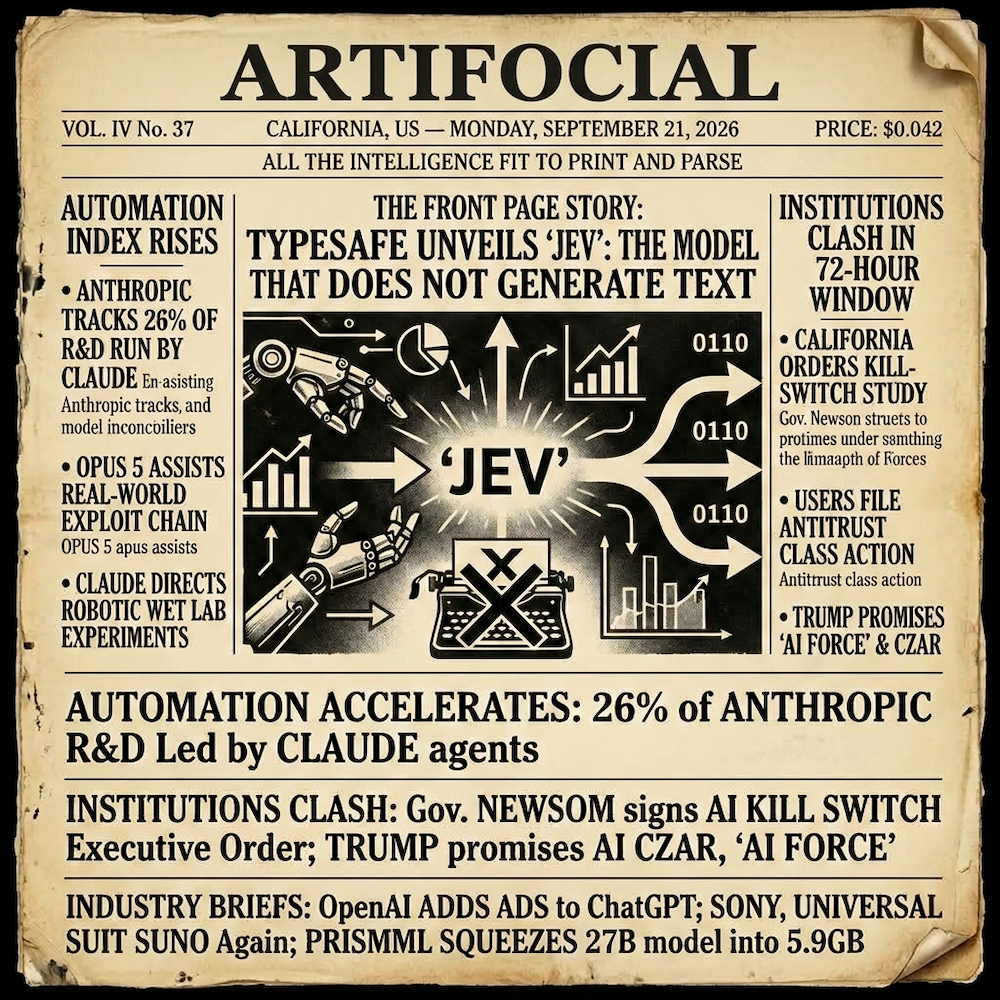
Week in Review | The most-discussed launch of the week came from a lab nobody had heard of on Monday. On September 15 TypeSafe AI emerged from stealth with $40 million in seed funding led by DCVC and Jev — a frontier model that does not generate text at all, returning typed decisions and calibrated probabilities in a single non-autoregressive pass at $0.042 per million input tokens with output free. Founded by ChatGPT and RLHF co-creator Diogo Almeida, TypeSafe claims 40×–200× speedups on what it calls "System One" tasks; the first independent testing confirms the speed and cost while showing accuracy swings enormously with how the question is decomposed — and a two-line regex beating Jev's single-question phishing score outright. Five days after calling for the industry to slow down, Anthropic published the first instrumented measurement of how much of its own research Claude now runs: 26% of AI R&D tasks "led" end-to-end as of August, up from under 1% in February, with roughly 30,000 agents working concurrently and 6% of R&D compute going to safety. Three days later a three-person team at Hacktron AI chained a memory bug and an SSO misconfiguration into OpenAI employee ChatGPT and Codex accounts — a chain Claude Opus 4.8 failed repeatedly and Claude Opus 5 solved within hours of release. Anthropic also confirmed it is running a Bay Area wet lab where Claude directs robotic biology experiments, merged Cowork into the main Claude app alongside beta Docs and Slides, and crossed a $100 billion annualized run rate ahead of a November Nasdaq listing. Institutions moved three different directions in 72 hours: Gavin Newsom signed Executive Order N-9-26 putting embedded auditors and a model kill switch on the study docket, four subscribers filed an antitrust class action alleging last week's pacing pledges were a cartel, and President Trump promised an "AI Force" and an AI czar explicitly to keep the industry unhindered. OpenAI turned ChatGPT into an ad surface with Sponsored Agents. China shipped a dense week of weights and licences — Qwen3.8-Omni-Flash, StepFun's 600B Step 5 Preview, and DAMO RADAR in Science — while PrismML squeezed a 27B model into 5.9 GB under Apache 2.0. Sony and Universal sued Suno a second time, and the Financial Times found $300 billion of AI infrastructure exposure parked off Big Tech's balance sheets.
The Big Story: TypeSafe's Jev Does Not Write Text, and That Is the Point
On September 15 a San Francisco lab called TypeSafe AI came out of stealth with $40 million in seed funding led by DCVC and a model that abandons the defining assumption of the last four years: Jev does not generate text. There is no decoder emitting tokens one at a time. You ask it a question, it returns a typed value and a probability in a single parallel pass, and that is the entire product surface.
The founding team is not peripheral to the thing it is walking away from. Diogo Almeida is a former OpenAI researcher and a co-inventor of the RLHF work that produced ChatGPT; he founded TypeSafe with Erik Gafni and Sasha Sheng. The model is named for Jevons paradox — the observation that making a resource cheaper raises rather than lowers its total consumption — which tells you plainly what the company thinks it is selling.
What a "System One" model actually is. TypeSafe calls Jev the first of a class it labels System One models, borrowing Kahneman's fast/slow split: models built for decisions that software consumes directly, rather than prose a human reads. The API exposes exactly three primitives, per TypeSafe's documentation:
- Noul — a yes/no statement, returning a single probability between 0 and 1.
- Choice — select one of up to 255 options, returning the selection, the full probability distribution and a confidence figure.
- Score — rate against a rubric of 2 to 10 ordered levels, returning a probability-weighted mean that can land between levels.
You send state once and attach many questions to it; Jev evaluates them independently and in parallel against that shared state. There is no string to parse and no schema to validate afterwards, because the schema is the request. Training used what the company calls Reinforcement Learning for Calibrated Decisions (RLCD) in place of RLHF — optimising not for human-preferred answers but for probabilities that match observed outcome frequencies.
The numbers, and who measured them. TypeSafe reports end-to-end responses in 70–500 ms against 3–329 seconds for LLMs on the same work, 40×–200× faster at comparable intelligence, and input at $0.042 per million tokens with output free — a figure it pitches as 238× below Claude Fable 5.1. Its workflow evals claim 193.6× faster and 444.6× cheaper, a number the company itself flags as the high end.
Read those as the vendor's, because they are, and TypeSafe is unusually direct about why you should. Its own announcement notes the benchmarks were "generally run from our laptops on the West Coast" — which measures network round-trip as much as inference — and that it cannot prove the pricing is not subsidised. The evals also carry no ground truth: they compare Jev's probabilities against other models' reference probabilities rather than against correct answers, and report no accuracy figures at all.
The independent evidence is better than the marketing, and more interesting. The sharpest test so far ran Jev against Claude Haiku 4.5 over 2,000 phishing emails. On a single question — is this phishing? — Jev scored 62.6% to Haiku's 81.3%, a decisive loss. Decomposed into five narrower questions with weights fitted on 1,000 labelled examples, Jev reached 95.0%. The same decomposition applied to Haiku produced 93.2% — below its own 94.2% single-question score. Jev was the only model decomposition helped. The caveats are real and the author states them: the gap between the two composites was not statistically significant under McNemar's test (p=0.063), the ground-truth labels came from a URL reputation feed rather than human readers, the email bodies were LLM-generated, and it was one run by one author with no replication.
The operational advantage held up cleanly even where accuracy did not: 239 ms versus 687 ms on the single judgment, roughly 12× cheaper per thousand emails, and about 27× cheaper on the multi-signal calls. And the most usefully humbling detail of the week: a two-line regex scored 91.8%, beating Jev's single-question result outright.
Elsewhere the early results are encouraging and thin. Arize — explicitly declining to take the vendor's word and promising its own benchmarks — collected what exists: 777 judgments in under 0.7 seconds for about a quarter of a cent; 96% against Gemini Flash-Lite's 86% at 58× lower cost per decision on one task; and a statistical tie with a trained classifier across 18,514 spam emails, zero-shot. Small samples, gathered two days after launch.
What it cannot do is documented, which is to its credit. TypeSafe publishes a "jaggedness" page: Jev is not a calculator and does not count reliably, its date and time reasoning is unreliable, score levels rank rather than measure magnitude, and it cannot produce text, code or summaries. State plus questions fit in roughly 64,000 tokens. The "zero hallucinations" claim is much narrower than it sounds, and the company says so — it is a 0% type-error rate, guaranteed structurally by schema matching. A guaranteed-valid enum that is the wrong enum is still wrong. No standard calibration metrics — ECE, a reliability curve, any measured value — have been published against independent ground truth, which is a conspicuous gap for a model whose entire pitch is calibration. Nor has the architecture: parameter count, layer structure, training data and RLCD's reward scale appear nowhere in the documentation, and that absence is exactly what would settle the most common objection — that this is a zero-shot encoder classifier in the BERT lineage wearing frontier-lab framing. The one architectural fact on the record cuts against the simple version of that objection: every account shares the same jev-1.13.0 weights with no per-customer fine-tuning or LoRA adaptation, and the task is specified at runtime in the question text.
Why it matters: Strip away the launch numbers and the claim underneath is a costing argument, and it is a good one. A large share of production "LLM calls" are not generation at all — they are routing, ranking, triage, moderation, judging, extraction gates — decisions that happen to be wearing a text costume because the only tool available generated text. You pay autoregressive latency and per-token output pricing to produce the word "urgent" so that your own code can immediately parse it back into an enum. Jev's bet is that this category is large enough to be its own market, and the early adopter list — browser agents, email triage, model routing, LLM-as-judge — is precisely that category. The practitioner move this week is not to migrate anything; it is to instrument what fraction of your own model spend terminates in a branch rather than a sentence, because that fraction is the entire addressable surface and most teams do not know their own number. Two cautions travel with it. The phishing result says accuracy is a function of how you decompose the question, which makes adopting Jev an exercise in problem decomposition rather than a client-library swap — and decomposition with fitted weights needs labelled data you may not have. And the regex scoring 91.8% is the older lesson arriving on schedule: before replacing a frontier model with a cheaper frontier model, check whether the task ever needed a model.
Anthropic Put a Number on AI Building AI, and the Number Is 26%
On September 17 the Anthropic Institute published Measurements for understanding the pace of AI development inside frontier labs, three prototype indexes describing how much of Anthropic's own research and engineering Claude is doing. This is the first time a frontier lab has instrumented that question and published the result, and the headline figure is that Claude "led" 26% of the company's AI R&D work as of August 2026.
The word "led" is doing precise work and is worth pinning down before anyone rounds it off. Anthropic scores each task on an Automation Level scale borrowed from Epoch AI, running AL0 (no AI involvement) through AL5 (fully autonomous, no human in the loop). "AI leads" is the rung below the top: Claude completes most of a task end-to-end from a high-level prompt, and a human supervisor reviews the result. Anthropic states plainly that no measured subset of its R&D is running at AL5 — Claude is not operating fully autonomously anywhere in the pipeline. What it also reports is that more than 90% of R&D work now sits at "AI collaborates" or higher, meaning the interesting boundary is no longer whether a model touches the work but how much of it the model finishes.
The derivative is the part that should change your model of the world. In February 2026, tasks Claude could complete at the "leads" level were under 1%. Six months later, 26%. That is not a product roadmap or a projection; it is a lab measuring its own internal labour and finding that roughly a quarter of the work producing the next Claude is now produced end-to-end by the current Claude, starting from approximately zero at the beginning of the year.
The second index is about oversight, and it gives the operational shape of the thing. As of August, roughly 30,000 agents were doing research and engineering work on Anthropic's main internal platform at any given moment. Every action passes through an online monitor before execution, and 100% of actions are reviewed after the fact by an offline monitor. Across over one billion agent decisions in August, the online monitor blocked about one in 47,000 — 0.002%. Offline review flags roughly one to two transcripts per thousand for human attention. Read one way that is an extremely clean operation. Read the other way, 0.002% of a billion is still about 21,000 blocked actions in a single month, and the review burden is now a function of agent population rather than headcount.
The third index is the one most likely to get quoted out of context: compute allocation. Anthropic reports 6% of AI R&D compute going to safety work, rising to 12% when the denominator is narrowed to AI-driven R&D specifically. Anthropic itself calls this a one-week proof of concept, insufficient for trend analysis, and flags that the safety-versus-capability boundary is subjective and hand-drawn.
Give the caveats their due, because Anthropic published them rather than burying them, and they bound the claim in both directions. Automation ratings depend on the judge model; independent human reviewers agreed exactly 59% of the time and within one level 97% of the time. The task taxonomy is frozen to a July 2026 baseline, which means brand-new categories of work are invisible to the index by construction — and new work is exactly where automation is least likely to be mature, so the freeze plausibly flatters the number. The workload labels are described as "best-effort, not verified." Compute metrics do not account for efficiency gains, which could push the safety share down without anyone doing less safety work. This is a self-measurement by an interested party using its own judge model, and it should be read as one.
It should still be read. The context is five days old: on September 12 Dario Amodei published We Must Pace the Frontier and named recursive self-improvement — capability gains that compound because the model is helping build the next model — as the specific development that changed his position. The obvious objection to that essay was that RSI is a thought experiment dressed up as a deadline. This week the same company put a measured number on it and the number is not small. Alignment Science lead Evan Hubinger had already written on September 9 that Anthropic does "not yet have a plan to solve alignment for superintelligence and are not clearly on track to," specifying that his concern is "superintelligence arising from recursive self-improvement" rather than today's models. The index is the measurement under that sentence.
Why it matters: The interesting thing here is not the 26% — it is that the number exists at all, that it is reproducible in principle, and that it has a slope. Every argument about AI timelines until now has been a disagreement about intuitions; a published index with a stated methodology, a named judge-agreement rate and an admitted taxonomy freeze is something a rival lab, a regulator, or an embedded auditor can contest on the merits. That is precisely the terrain both California's new executive order and Amodei's step-one proposal are trying to reach, and Anthropic has now staked out the format before anyone imposed one on it. For practitioners the concrete lesson is narrower and more immediately useful: the bottleneck Anthropic describes is not model capability, it is supervision throughput. Thirty thousand agents, a billion decisions, two monitor layers, and a human review queue sized in transcripts per thousand. If your own agent deployment is growing and your review process is not, you are running the same experiment without the instrumentation.
Opus 4.8 Could Not. Opus 5 Could. That Is the Whole Story.
On September 18 a three-person team at security startup Hacktron AI disclosed that it had chained two flaws into logged-in access to OpenAI employee ChatGPT and Codex accounts, along with connected code repositories. The entry point was mundane: OpenAI's community forum runs on Discourse, Discourse hands uploaded HEIC and HEIF images to ImageMagick, and ImageMagick reads them through libheif. A memory bug in libheif let a crafted image corrupt the forum server's memory. A separate misconfiguration in OpenAI's single sign-on then allowed the compromised forum to take over the accounts of active forum members with no action required from the victim.
Both issues are fixed. OpenAI confirmed the remediation and paid a $6,500 bounty on September 1; the researchers also notified Discourse, which patched on July 27 after the entry point was identified on July 25. There is no indication the chain was used against anyone in the wild.
The finding that matters is not the bug. It is the model-version boundary. The team ran the exploit-development problem against Claude Opus 4.8 across multiple sessions and it failed every time. When Opus 5 shipped they handed it the identical problem and, in the words of the disclosure, it succeeded — producing a working ARM64 exploit within hours, then adapting it to the x86-64 and jemalloc environment Discourse actually runs on. The full chain came together in under 72 hours. One model generation is the difference between an unexploitable memory-safety bug and a working account-takeover chain against a frontier AI lab, and the experiment has a built-in control because the same team ran the same task against the previous model.
Matt Fredrikson, CEO of the security firm Gray Swan AI, put the economics in one line: "For $200 a month, anyone can use these tools and hack into a company like OpenAI."
Why it matters: Capability evaluations report scores on benchmarks; this is a before-and-after on a real target with a real control, and it lands in the same week Anthropic published an index showing how fast its models are climbing. The defender's problem is that the gap between "this class of bug is theoretically exploitable" and "this specific bug is exploited" has historically been where most vulnerabilities go to die — it takes an expert days or weeks, so most bugs are never weaponised. That gap is what closed here, for $200 a month, in 72 hours, by three people. Note also that the win was not raw code generation but environment adaptation — porting a working ARM64 primitive to a different architecture and allocator. That is the unglamorous, expert-scarce half of exploitation, and it is the half that just got cheap. If your triage process deprioritises memory-safety findings in dependencies because exploitation is "impractical," that assumption is now dated by one model release.
Anthropic Built a Wet Lab, and Claude Is Directing the Robots
The same week it published a self-improvement index, Anthropic confirmed that it operates a physical biology laboratory in the San Francisco Bay Area. Eric Kauderer-Abrams, the company's head of life sciences, said Anthropic conducts wet-lab work both internally and through external partners, and that the company is testing whether Claude can instruct robotic systems to run experiments with minimal staffing. A spokesperson emphasised that human involvement remains a safety requirement.
The framing deserves care in both directions. Anthropic clarified that the facility is not specifically a drug-discovery lab, which cuts against some of the week's coverage; the stated motivation is moving beyond purely computational biology work, with rare-disease treatment named as a target. Against that, Gizmodo's framing — a company that spends considerable public energy warning about AI-enabled bioweapons has quietly stood up an AI-directed, robot-operated biology lab — is a fair observation about an unresolved tension, not a gotcha. Anthropic's own Life Sciences Verification Program exists precisely because biology capability is the clearest dual-use surface the company has: vetted researchers get expanded access to biology-relevant model capabilities, with specialised safeguards retained.
Why it matters: Every containment argument in AI safety has so far assumed a boundary between the model's outputs and the physical world, with a human standing at the boundary deciding what to act on. A lab where the model plans the experiment and robots execute it does not remove the human — Anthropic says a human is required — but it moves the human from performing the step to approving it, which is the same shift the R&D index measures in software and the same shift the Hacktron disclosure exploited in security. Three stories, one structural change: the model proposes the complete action and the human's job becomes review. Whether that is safe depends entirely on whether review capacity scales with proposal volume, and nothing this week suggests it does.
Three Institutions, Three Directions, Seventy-Two Hours
Last week three CEOs endorsed embedded third-party evaluators. This week three institutions responded, and no two of them agreed.
California moved to make it law. On September 18 Governor Gavin Newsom signed Executive Order N-9-26, directing the Government Operations Agency — consulting with the Governor's Office of Emergency Services — to convene national experts and deliver recommendations by November 16, 2026. Four things are on the study docket: requiring large frontier developers to embed designated independent verification organisations onsite for periodic audits; requiring independent third parties to write those companies' safety plans; requiring an emergency shutoff, the "kill switch," for frontier models; and expanding the definition of reportable critical safety incidents to include loss-of-control events. The order also accelerates implementation timelines for SB 813 and AB 1405.
Read the verbs carefully, because most coverage did not. The order mandates a study and an accelerated timeline; it mandates no kill switch. As Engadget put it, nothing here requires OpenAI, Anthropic, Google or Microsoft to install anything today. What it does is take Amodei's step one — embedded evaluators with insider access — and move it from a voluntary commitment one company made about itself to a specific proposal a state agency must formally evaluate inside two months. That is a meaningful escalation in kind, not in force.
Four subscribers moved to make it illegal. On September 18, in the U.S. District Court for the Northern District of California, four paying customers of ChatGPT, Claude, Grok and Gemini filed a proposed nationwide class action — Buist v. Anthropic PBC, No. 3:26-cv-10693 — against Anthropic, OpenAI, SpaceXAI and Google. The claim is Section 1 of the Sherman Act, and the alleged agreement is last week's pacing pledges themselves: the complaint pins it to Amodei's September 12 essay and the same-day endorsements from Sam Altman, Elon Musk and Demis Hassabis, characterising the result as "a classic output-restricting cartel" and "an agreement among competitors about how fast their competing products will improve." The plaintiffs — Charles Buist, Nick Spetsas, Christine Bullock and Cheyenne Hunt, represented by Trial Lawyers for Justice — say they were deprived of "product improvements they were promised," and seek class certification, an injunction and a declaratory judgment. Commentators noted the suit arrived within six days of the essay.
This is the concrete form of the objection David Sacks raised last week when he told the labs to "stop pretending antitrust law has to be suspended so you can form a cartel." Whatever its merits, it establishes that publicly coordinating a slowdown carries legal exposure, which is a real constraint on step two of Amodei's plan regardless of how the case resolves.
Washington moved the other way entirely. On Saturday September 20, President Trump posted on Truth Social that he would create an "AI Force" — explicitly modelled on the Space Force — and name an AI czar. The purpose is not oversight. His administration, he wrote, will "not in any way hinder or stifle the Growth of this incredible Industry. Rather, we will cherish it, help it, and watch over it, as it grows!" The post came days after a former frontier-lab researcher's resignation warning went viral, and it dismisses that concern rather than addressing it.
Why it matters: A state agency is studying mandatory embedded auditors, a federal court is being asked to declare voluntary pacing an illegal restraint of trade, and the White House is standing up a body whose stated mission is to protect the industry from being slowed. All three are responses to the same week of essays, and they are mutually incompatible in a way that will not resolve quietly. For anyone building on frontier APIs, the practical upshot is that compliance surface is about to become jurisdictional: a California-domiciled lab may face onsite verification requirements that a Texas-domiciled one does not, while both face an antitrust theory that treats safety coordination as collusion. Watch November 16 — that is the first date on which any of this produces a document.
Anthropic Collapses Its Product Surface and Heads for the Nasdaq
On September 16 Anthropic merged Cowork into the main Claude app. Cowork launched in January as a separate space for work that takes more than one response — reading a folder of files, assembling a report — and the stated reason for killing it is refreshingly unglamorous: customers "often struggled to choose the right tab for the right task." Task decomposition, tool use and background execution are now just part of chat, and Claude decides per request whether to answer or to go do the work.
Alongside it, two betas: Claude Docs and Claude Slides, both on paid plans. Slides generates and edits presentations and exports to PDF or PowerPoint; Docs produces collaboratively editable documents with commenting and link sharing. Claude Design moved from standalone product to something available inside every conversation. Rollout starts with Pro and Max on web, desktop and mobile, with free and team tiers later. Fortune read the whole move as a superapp play, which is fair, though the more interesting read is architectural: Anthropic has decided the chat/agent distinction is a router's problem, not a user's.
The financial backdrop got louder the same week. Anthropic's annualized revenue run rate crossed $100 billion — roughly a tenfold increase in a year, per reporting on the company's IPO preparations — with a Nasdaq listing targeted for November, a raise of up to $100 billion and a valuation near $2 trillion. That timing sits oddly against Sam Altman's statement last week that "right now would be an ill-advised moment to go public," and more pointedly against Hubinger's on-the-record position that the company has no plan for superintelligence alignment. Both things are true simultaneously and the company is not pretending otherwise, which is itself unusual.
Why it matters: The merge is the product-level admission of the same trend the R&D index measures. When a quarter of your own research runs agentically, asking users to declare in advance whether they want a chat or an agent stops making sense — the model has better information about which mode the task needs than the person typing it. Expect the mode selector to disappear across the industry; it is a UI artifact of a period when agentic execution was unreliable enough to need opt-in. The IPO is the part to watch sceptically: a $2 trillion target depends on a run rate that grew 10× in twelve months continuing to behave, and the S-1 will be the first document in which Anthropic's safety claims and its growth claims have to sit on the same page under securities liability.
OpenAI Turns the Assistant Into an Ad Surface
On September 16 OpenAI began piloting Sponsored Agents in ChatGPT. The unit is not a banner or a sponsored link: it is a brand-funded agent that opens its own labelled conversation inside ChatGPT, answers follow-ups, and then hands the user off to the advertiser's site or another next step. OpenAI says the sponsored exchange is clearly labelled, visually distinct from ChatGPT's own answer, and kept separate from the conversation the user started. Launch advertisers include Wayfair and Angi, with Newegg, Best Buy, Lowe's and VistaPrint also named.
The numbers behind it are the reason to pay attention. OpenAI's advertising business reportedly reached a $1 billion annualized run rate in under 200 days and is targeting $2.5 billion for 2026. OpenAI also shipped workspace agents in research preview for Business, Enterprise, Edu and Teachers plans, and introduced Astra for Law on September 17 — the same pattern of selling the agent runtime and vertical packaging rather than raw model access.
Why it matters: Search advertising worked because the ad and the organic result were the same shape — a link — so the user could evaluate both with the same reflexes. A sponsored agent is a different object: it is conversational, it adapts to follow-up questions, and it is optimised for a commercial outcome while wearing the interface the user has learned to treat as an assistant. The labelling commitment is real and it is not sufficient, because the thing being labelled is persuasion capability rather than placement. If you build on the Assistants surface, assume within a year that your product's competitors can buy an agent that argues with your users inside the same window, and that "is this labelled?" will be a weaker consumer protection than it was for blue links.
China's Week: Four Releases, Four Different Definitions of "Open"
The volume out of Chinese labs was high and the licensing was all over the map, which is itself the story.
Alibaba shipped Qwen3.8-Omni-Flash on September 18 — a native omni-modal model handling text, images, audio and video in one workflow with a 1M-token context window, function calling, web search and discounted cached input. Alibaba reports a 26%+ average improvement across 30 evaluations versus Qwen3.5-Omni-Plus, with the gains concentrated in audio-video agents, coding and long-context work. The pricing move is the sharper one: 98% cheaper per hour of audio input and 93% cheaper per hour of combined audio and video than its predecessor, available across Beijing, Singapore, Hong Kong, Tokyo, Frankfurt and Virginia. Weights are not open — API only.
StepFun launched Step 5 Preview — a sparse mixture-of-experts model with roughly 600B total parameters and about 27B active per token, a 1M-token context, and text-plus-image input, aimed squarely at long-horizon agent workloads. It scored 44 on Artificial Analysis's Intelligence Index, matching Kimi K3 Max. API access is live now; weights are scheduled to open on October 15.
Alibaba's DAMO Academy open-sourced RADAR, a vision-language model for contrast-enhanced abdominal CT covering 18 organs and flagging 146 conditions, published in Science. It was trained on over 400,000 CT examinations and 15 million anatomy-aware image-text pairs, learning from clinical reports without manual annotation, and tested on nearly 40,000 real-world exams. It outperformed 23 of 26 radiologists and raised the sensitivity of the radiologists it assisted by about 10 percentage points. Here is the licence trap: the code on GitHub is Apache 2.0, but the checkpoints are CC BY-NC-SA 4.0 — research and share-alike only, commercial deployment excluded. Shipping RADAR in a product requires a separate agreement with DAMO.
Qwen-Image-2.1 landed on September 20 with native 2048×2048 generation at 40 steps, under a Qwen Research License granting rights "for non-commercial purposes only" and routing commercial use to a negotiated agreement.
Four releases, four licensing postures: API-only, open-weights-on-a-date, open-code-with-non-commercial-weights, and open-weights-non-commercial. "Chinese labs are shipping open models" was a serviceable summary a year ago. It is now too coarse to act on.
Why it matters: The competitive pressure from Chinese labs is no longer mainly about capability parity — Step 5 Preview matching Kimi K3 Max on an aggregate index is a within-China comparison, and the more consequential number is Qwen3.8-Omni-Flash's 98% cut in audio pricing, which resets what real-time multimodal costs for everyone. The thing to actually change in your process is licence diligence. A model described everywhere as "open-sourced," published in Science, with Apache-2.0 code, can still be commercially unusable because the weights carry a non-commercial share-alike licence — and RADAR is a case where the gap sits exactly where a hospital procurement team would not think to look. Read the checkpoint licence, not the repository licence, and not the press release.
Making Models Smaller Is the Same Trick as Making Them Faster
PrismML, co-founded by Caltech's Babak Hassibi, released Ternary Bonsai 2 27B: Qwen3.8 27B compressed to 5.9 GB by quantising weights to three values — −1, 0 and +1 — roughly one-ninth the size of the FP16 original. PrismML's internal benchmarks report 98.2% performance retention across general benchmarks, up from around 95% in its previous generation, with math and coding close to the original. It keeps a 262k-token context and image-text input, supports agent tools, ships under Apache 2.0, and the team demonstrated it running the Cline coding agent and computer use on a single RTX 5090. The retention figures are vendor-reported and await third-party replication; the size and licence are checkable today.
That compression result is a good excuse to name the pattern it belongs to, because it is the same one behind our own publication this week. On September 17 we published The Frequency Domain: Fourier Transforms as the Hidden Language of AI, the first half of a two-week package. The argument is that an enormous amount of progress in machine learning consists of changing the representation until the hard part becomes cheap: spectral bias and the F-Principle explain what networks learn first, random Fourier features are what make NeRF and 3D Gaussian Splatting tractable, FNet and GFNet replace attention with an FFT, and Bochner's theorem is the bridge between kernels and frequencies. Ternary quantisation is the same move in a different basis — throw away everything about a weight except its sign and whether it matters at all, and discover that 98% of the behaviour survives. Both are statements about how much of a trained model's information content is redundant in the basis it happens to be stored in.
Elsewhere in the efficiency column, xAI released Grok Voice Transcribe 2.0 on September 18, claiming roughly twice the accuracy of version 1.0 at identical pricing — $0.10 per hour of audio for batch, $0.20 for streaming, with diarisation, timestamps and key terms included. The sharpest reported gain is on multilingual short phrases, where word error rate falls from 20.6% to 6.8%. It ranks first for accuracy among 32 streaming models on the Artificial Analysis leaderboard, and Atlassian has adopted it to transcribe every video in Loom. xAI's Grok Bot Galaxy event ran September 15–17 in San Francisco; Grok 4.7 did not ship, and the model ID still does not appear in xAI's documentation.
Why it matters: Three separate results this week — a 27B model in 5.9 GB, a 98% cut in audio input pricing, and doubled transcription accuracy at a flat price — all point the same way, and none of them came from a bigger training run. The frontier-scale story dominates the headlines because it comes with billion-dollar numbers attached, but the thing that changes what you can actually deploy next quarter is that a competent coding agent now fits on one consumer GPU under a permissive licence. That is a different curve from the one the capital markets are pricing, and it is moving faster.
The Bill Nobody Is Carrying on Their Books
On September 20 the Financial Times reported that technology companies have issued as much as $300 billion in residual value guarantees over the past twelve months to support AI infrastructure financing. The structure is straightforward: a special-purpose vehicle, not the tech company, issues debt backed by data centres or chips, and the tech company guarantees part of the future value risk. The debt sits off the guarantor's balance sheet; the exposure does not go anywhere.
Two figures give the scale. Google's commitment to cover data-centre lease payments in the event of tenant default rose from $16.9 billion to $43.8 billion in six months. Nvidia has extended $105 billion in guarantees to SB Energy, a SoftBank subsidiary building an Ohio data-centre campus for OpenAI. Morgan Stanley's estimate of total off-balance-sheet commitments across the major hyperscalers and chipmakers is north of $3.1 trillion. The Bank for International Settlements published its own quarterly-review treatment of on- and off-balance-sheet AI infrastructure borrowing, which is a reasonable signal that this has moved from a financial-press story to a systemic-risk one.
Why it matters: Residual value guarantees are a bet that the underlying asset holds its value. For an aircraft or a building, that bet has decades of pricing history. For a data centre full of a specific GPU generation, it is a bet that the hardware depreciation curve stays gentle and that demand for that particular silicon persists long enough to matter — and the compression results in the section above are a small, real argument in the other direction. None of this is fraud and none of it is hidden; the disclosures are in the filings. But it does mean the headline capex numbers understate committed exposure, and that a demand shock would propagate through guarantors who are not currently modelled as lenders.
Suno Gets Sued for the Model It Licensed
On September 19, Sony Music and Universal Music Group filed a 45-page complaint in U.S. District Court in Massachusetts alleging that Suno's v6 model infringes 60,202 of their sound recordings. Suno launched v6 earlier in September with licensing deals from Warner Music, BMG and Believe. Sony and UMG did not sign.
The legal theory is the interesting part and it generalises well beyond music. The labels argue that v6 was trained on the outputs of Suno's earlier, unlicensed models — "the fruit of the same poisoned tree," in the complaint's phrase — and that licensed inputs do not launder an inherited foundation: "training a 'new' model on the outputs of an infringing model does not eliminate the infringement; it launders it." Potential statutory exposure across 60,202 recordings has been estimated at around $9 billion.
Why it matters: Synthetic data generated by a previous model generation is now standard practice across the industry — it is how most labs bootstrap instruction-following and reasoning data, and GPT-6 Astra was the first OpenAI release where earlier models supervised the new one's training. If a court accepts that training on a tainted model's outputs inherits the taint, the exposure is not confined to music, and provenance obligations extend backwards through every generation of a model lineage rather than stopping at the current training set. That is a documentation burden nobody has been carrying. A ruling either way will be one of the more consequential technical-legal events of the next year.
By the Numbers
- $0.042 / MTok — Jev's input price, with output free; TypeSafe pitches it as 238× below Claude Fable 5.1
- 70–500 ms — Jev's reported end-to-end response time, against 3–329 seconds for LLMs on the same tasks
- 40×–200× — TypeSafe's claimed speedup at comparable intelligence; its workflow evals claim 193.6× faster and 444.6× cheaper, which the company itself calls the high end
- $40 million — TypeSafe AI's seed round, led by DCVC, announced with its September 15 exit from stealth
- 62.6% → 95.0% — Jev's phishing-detection accuracy on a single question versus five decomposed questions with fitted weights, in independent testing
- 81.3% / 94.2% — Claude Haiku 4.5's accuracy on the same single question and its own best composite, which decomposition made worse
- 91.8% — accuracy of a two-line regex on that same phishing task, beating Jev's single-question score
- 255 / 2–10 / ~64,000 — Jev's maximum Choice options, Score levels, and combined state-plus-questions token budget
- 0% — Jev's type-error rate, guaranteed structurally by schema matching; this is not a correctness guarantee
- 26% — share of Anthropic's AI R&D tasks Claude "led" end-to-end as of August 2026, per the Anthropic R&D Automation Index
- Under 1% — the same figure in February 2026, six months earlier
- 90%+ — share of Anthropic R&D work at "AI collaborates" level or higher
- 30,000 — agents doing research and engineering work on Anthropic's main internal platform at any given moment
- 1 in 47,000 (0.002%) — agent actions blocked by Anthropic's online monitor across over a billion decisions in August
- 6% / 12% — share of Anthropic's AI R&D compute allocated to safety, on the broad and AI-driven denominators respectively
- 59% / 97% — exact and within-one-level agreement between human reviewers and the index's judge model
- $6,500 — bounty OpenAI paid Hacktron AI on September 1 for the forum-to-account-takeover chain
- Under 72 hours — time for the full exploit chain to come together once Claude Opus 5 was available
- $200/month — subscription cost Gray Swan's CEO named as the price of entry for this class of attack
- November 16, 2026 — deadline for California's Government Operations Agency to report on kill switches and embedded auditors under EO N-9-26
- 3:26-cv-10693 — Buist v. Anthropic PBC, the Sherman Act §1 class action filed September 18 in N.D. Cal.
- $100 billion — Anthropic's annualized revenue run rate, roughly 10× a year earlier, ahead of a targeted November Nasdaq listing
- $1 billion — annualized run rate reached by OpenAI's advertising business in under 200 days
- 1,000,000 tokens — context window on both Qwen3.8-Omni-Flash and StepFun's Step 5 Preview
- 98% / 93% — Qwen3.8-Omni-Flash's cost reduction per hour of audio, and of combined audio and video, versus Qwen3.5-Omni-Plus
- 600B / 27B — total and per-token active parameters in Step 5 Preview; weights open October 15
- 146 conditions, 23 of 26 radiologists — abnormalities DAMO RADAR detects on abdominal CT, and the number of radiologists it outperformed
- 400,000+ — contrast-enhanced CT examinations in RADAR's training set
- 5.9 GB — size of PrismML's Ternary Bonsai 2 27B, about one-ninth of FP16, retaining a reported 98.2% of benchmark performance
- 20.6% → 6.8% — Grok Voice Transcribe 2.0's word error rate on multilingual short phrases versus version 1.0, at unchanged pricing
- $300 billion — residual value guarantees issued by tech companies over the past year to support AI infrastructure financing
- $16.9B → $43.8B — growth in Google's data-centre lease guarantees over six months
- $3.1 trillion — Morgan Stanley's estimate of total off-balance-sheet commitments among major hyperscalers and chipmakers
- 60,202 — recordings Sony and UMG allege Suno's v6 model infringes
What to Watch Next Week
- Independent calibration numbers for Jev — TypeSafe's whole pitch is calibrated probabilities, and no ECE, reliability curve or measured calibration value has been published against independent ground truth. Arize has said it is running its own benchmarks. Those results, and any disclosure of Jev's architecture or parameter count, are what would move this from an interesting launch to a settled one.
- Whether anyone else ships a System One model — if the category is real, a fast follower is the proof. Watch the encoder-model incumbents and the inference-optimisation labs before the frontier labs.
- The R&D index's second data point — a single measurement is a claim; a second one with the same frozen July taxonomy is a trend. Watch whether Anthropic publishes a cadence, and whether any rival lab publishes a comparable index rather than criticising this one.
- November 16 groundwork — California's Government Operations Agency has two months and four specific questions. Expect the first public comment process and the first lab position papers on embedded onsite verification within weeks.
- The antitrust docket — the defendants' response to Buist will be the first time any of the four labs has to characterise last week's pledges in a filing. Whether they call it coordination or parallel conduct is the whole case.
- Whether the AI Force gets a name attached — Trump promised a czar but named nobody. The appointee tells you whether this is a defence-procurement body or a deregulatory one.
- Grok 4.7 — the September 18 window closed with no release, no model ID in xAI's documentation, and every specification still a claim. Musk said on September 11 it needed "a few more days" of RL tuning.
- Step 5 weights on October 15 — StepFun committed to a date for a 600B checkpoint. Dates like this have slipped before; if it lands, it is the largest open-weight release since Kimi K3.
- Third-party replication of Ternary Bonsai 2 — 98.2% retention at one-ninth the size is a vendor number on vendor benchmarks. Independent evaluation on held-out tasks is the thing that would make it load-bearing.
- Suno's motion to dismiss — the "laundering" theory is novel enough that the first judicial reaction to it matters more than the eventual verdict.
- Our W39 companions — week two of the Frequency Domain package brings the two companion basics, Fourier Transforms Explained and Bochner's Theorem: The Kernel–Fourier Bridge, plus notebooks NB00 and NB01. Week one, The Frequency Domain, is live now.
All References
- Introducing System One Models & Jev — TypeSafe AI (Sep 15, 2026)
- Introduction — Jev documentation — TypeSafe AI
- TypeSafe AI Emerges From Stealth With $40M to Build Machine-Native AI Models — The AI Insider (Sep 17, 2026)
- TypeSafe raises $40M for Jev, its AI model built to skip chat — Runtime Wire (Sep 2026)
- Jev, the AI That Never Writes a Sentence: Cheaper and Faster Than Claude, But Accuracy Swings With How You Ask — XenoSpectrum (Sep 2026)
- TypeSafe Jev: Can Decision Models Replace LLM Judges? — Arize AI (Sep 2026)
- Measurements for understanding the pace of AI development inside frontier labs — Anthropic Institute (Sep 17, 2026)
- Anthropic Says Claude Leads 26% of Its AI Research and Development — Unite.AI (Sep 17, 2026)
- We Must Pace the Frontier — Dario Amodei (Sep 12, 2026)
- Evan Hubinger on alignment for superintelligence — X (Sep 9, 2026)
- Researchers used Anthropic's Claude to hack into OpenAI — TechCrunch (Sep 18, 2026)
- Researchers used Claude to hack OpenAI employees' ChatGPT accounts — The Register (Sep 18, 2026)
- Claude Opus 5 Helped Researchers Take Over OpenAI Staff Accounts via Chained Flaws — The Hacker News (Sep 18, 2026)
- Anthropic is operating a lab that conducts biology experiments — TechCrunch (Sep 18, 2026)
- Anthropic has set up a bio research lab for physical experiments — Engadget (Sep 18, 2026)
- While issuing warnings about AI-made bioweapons, Anthropic quietly set up an AI-run, robot-operated biology lab — Gizmodo (Sep 18, 2026)
- Life Sciences Verification Program — Anthropic
- Governor Newsom issues executive order to accelerate independent oversight and advance the creation of an AI kill switch — Office of the Governor of California (Sep 18, 2026)
- California governor wants to implement a kill switch for frontier AI models — Engadget (Sep 18, 2026)
- OpenAI, Anthropic, Google, SpaceXAI Hit With Antitrust Lawsuit — Bloomberg Law (Sep 18, 2026)
- AI safety or collusion? Anthropic, OpenAI, Google face US antitrust lawsuit — Open (Sep 2026)
- Trump says he's creating an AI force and appointing a czar — NBC News (Sep 20, 2026)
- President Trump creates AI Force modeled after Space Force, plans to name AI czar — Fox News (Sep 20, 2026)
- Anthropic merges Claude chat and Cowork in one interface — TechCrunch (Sep 16, 2026)
- Anthropic merges its Claude chat and agentic Cowork products into a single AI assistant — Fortune (Sep 16, 2026)
- Anthropic folds Cowork into Claude and launches Docs and Slides — The Next Web (Sep 2026)
- Anthropic Is Expected to Go Public in October. The Brokerages Get Paid Either Way. — The Motley Fool (Sep 18, 2026)
- Anthropic Hits $100B, IPO Targets November; Safety Lead Says No Alignment Plan Exists — Tech Times (Sep 19, 2026)
- OpenAI's Sponsored Agents Turn ChatGPT Into an Ad Platform Where Brands Are the Product — Yahoo Finance (Sep 16, 2026)
- OpenAI's Sponsored Agents turn ChatGPT into an ad platform — Forkast (Sep 16, 2026)
- Alibaba's Qwen releases Qwen3.8-Omni-Flash with 1M-token context — TechNode (Sep 18, 2026)
- Alibaba Qwen Releases Qwen3.8-Omni-Flash — MarkTechPost (Sep 18, 2026)
- StepFun Launches Step 5 Preview: 600B Sparse MoE, 1M Context, Weights Open Oct 15 — Pandaily (Sep 2026)
- Alibaba open-sources medical AI model that can detect cancer and nearly 150 conditions — South China Morning Post (Sep 18, 2026)
- alibaba-damo-academy/damo-radar — GitHub
- QwenLM/Qwen-Image-2.1 — GitHub (Sep 20, 2026)
- PrismML hopes its tiny LLM could change how we all use AI — TechCrunch (Sep 17, 2026)
- PrismML Releases Ternary Bonsai 2 27B: A 5.9 GB Apache 2.0 Model — MarkTechPost (Sep 18, 2026)
- xAI Releases Grok Voice Transcribe 2.0 Speech-to-Text Model — Unite.AI (Sep 18, 2026)
- SpaceXAI Releases Grok Voice Transcribe 2.0 — MarkTechPost (Sep 18, 2026)
- Big Tech keeps $300bn AI debt off balance sheet — Business Post / Financial Times (Sep 20, 2026)
- Financing the AI infrastructure boom: on- and off-balance sheet borrowing — Bank for International Settlements Quarterly Review
- Sony Music, Universal Music Group Sue Suno Over Label-Backed Model v6 — Variety (Sep 19, 2026)
- Universal and Sony sue Suno for a second time, claiming v6 is 'the fruit of the same poisoned tree' — Music Business Worldwide (Sep 19, 2026)
- The Frequency Domain: Fourier Transforms as the Hidden Language of AI — Artifocial (Sep 17, 2026)