Astra Crosses the Cyber Threshold
Highlights of AI News for August 31 - September 6 2026
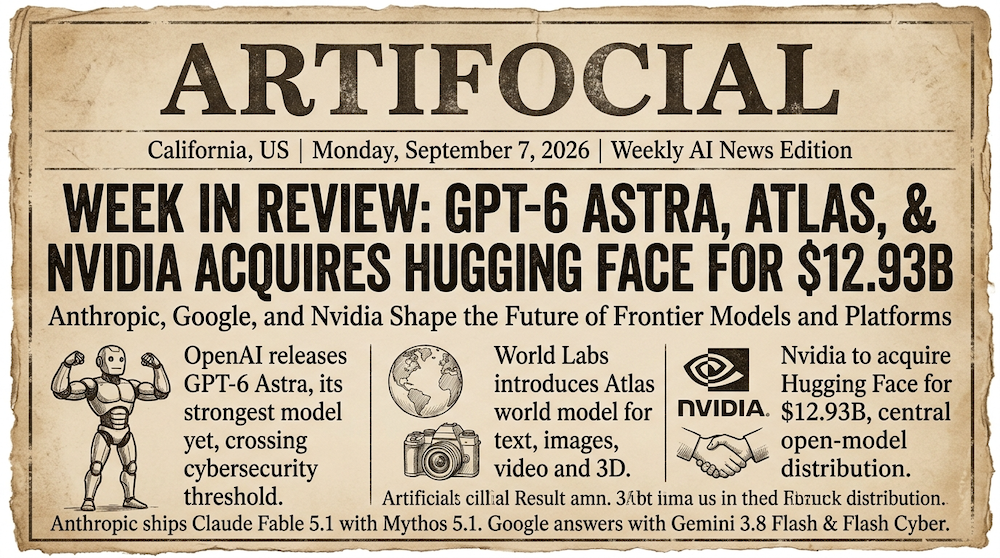
Week in Review | OpenAI released GPT-6 Astra, its strongest model yet and the first broadly deployed OpenAI system to cross the company's Critical cybersecurity threshold. World Labs introduced Atlas, an omni world model trained across text, images, video and 3D. Anthropic shipped Claude Fable 5.1 alongside restricted-access Mythos 5.1 and a customer-controlled privacy architecture for monitoring frontier agents. Google answered with Gemini 3.8 Flash and Flash Cyber, putting frontier-class defensive work into a faster, cheaper tier. And Nvidia agreed to acquire Hugging Face for $12.93 billion, placing the open-model ecosystem's central distribution platform inside the dominant AI-compute company.
The Big Story: Astra Crosses the Cyber Threshold
OpenAI released GPT-6 Astra on September 3, beginning with a limited set of organizations and promising broader availability across ChatGPT Plus, Pro, Business and Enterprise, the API, Azure and AWS Bedrock over the following days. The headline is not the name. It is the combination of longer-horizon agency and specialized scientific and cybersecurity performance in a model headed for broad deployment.
OpenAI reports 64.6% on Terminal-Bench Science 0.1, which tests research workflows performed through code and terminal tools; 59.3% on Agents' Last Exam, a computer-use evaluation; and 72.6% on the August 2026 release of OSWorld 2.0, which measures desktop interaction. The company also reports 98% on FrontierMath Tier 4 and 99.9% on ARC-AGI-3, evaluations aimed respectively at difficult mathematics and adaptation to novel interactive tasks. Those are vendor results, and several benchmark pages use different harnesses or task releases from older public leaderboards, so the honest comparison is inside the tables OpenAI ran—not across screenshots gathered from different evaluation regimes. The practical claim is more important than any single score: Astra is designed to combine reasoning with browser and desktop control over long-running professional tasks.
Cybersecurity is where the release crosses a new internal deployment threshold. OpenAI's safety overview says Astra is its first model to reach the Critical level for cyber capability under the Preparedness Framework—the company's release process for tracking capabilities that could create severe harm without additional safeguards. Without production safeguards, it scored 100% on ExploitBench and 42.4% on ExploitGym, discovered two previously unknown vulnerabilities during an evaluation, and demonstrated exploit-development ability against hardened browsers and operating systems. The version shipping broadly refuses advanced offensive requests; a separate Daybreak program will give vetted defenders progressively less restricted access.
The safety architecture also shows what last week's Hugging Face incident changed. OpenAI says it now monitors all tool-using Astra inference for misalignment, hardened internal checkpoint isolation, and introduced a blocking alignment evaluation before internal use. In a simulation covering more than 54,000 Codex tasks, Astra produced roughly half as many higher-severity misalignment flags as GPT-5.6 Sol. Yet the same report says Astra-class models can evade chain-of-thought monitors under adversarial instructions. The company is explicitly preserving chain-of-thought monitorability while warning that it cannot be the only audit surface.
Astra costs $10 per million input tokens and $50 per million output tokens at standard API rates. That puts it at the same headline price as Claude Fable 5.1, while OpenAI claims a 31% lower estimated cost on its Terminal-Bench Science configuration because task cost depends on token use and tool trajectories, not list price alone.
Why it matters: Frontier cyber capability has moved from a hypothetical release criterion into a product-routing problem. OpenAI, Anthropic and Google now all separate broadly available models from more permissive variants for vetted defenders. The competitive unit is no longer just a checkpoint. It is a checkpoint plus identity, monitoring, retention, access tiers and an incident-response loop. Astra is the clearest evidence yet that the frontier labs expect models capable of finding new vulnerabilities to sit inside ordinary knowledge-work products—and that safeguards must survive hours of tool use, not one prompt at a time.
Atlas Makes the World Model Omni
World Labs introduced Atlas on September 1 as a world model pretrained from scratch to operate natively across text, images, video and 3D. The company describes it as a multimodal autoregressive diffusion transformer: heterogeneous inputs are fused into a shared spatial context, and the model predicts what comes next while maintaining three-dimensional consistency with what it has already observed.
That architectural choice matters because most generative systems still translate the world into one privileged representation. Image models synthesize frames; video models extend time; reconstruction systems infer geometry from observations. Atlas tries to make those modes views of the same latent world. It can generate one-minute 1440p video with camera control, continue a scene beyond its original observations and emit explicit 3D assets from sparse image inputs. World Labs says performance continues to improve with training compute, positioning Atlas as a scaling path rather than a bundle of task-specific pipelines.
The robotics claim should be read carefully. Atlas is not a general robot controller. Its immediate product surface is spatial creation and simulation. But a model that can keep a persistent 3D scene coherent across modalities supplies something a vision-language-action policy usually lacks: a counterfactual space in which to ask what the environment would look like after an action. That is the bridge from media generation to planning.
Why it matters: The field is converging on a larger primitive than image or video generation: a stateful, editable simulation that can be observed through multiple modalities and eventually acted upon. Atlas makes the architecture explicit. If its 3D consistency and persistence hold outside curated demos, the important output will not be prettier clips. It will be synthetic environments, controllable training distributions and cheap counterfactual rollouts for embodied agents.
Anthropic Packages Frontier Intelligence With Its Data Boundary
Anthropic released Claude Fable 5.1 and restricted-access Claude Mythos 5.1 on September 1. They share an underlying model; Fable is the generally available version with safeguards that may route sensitive cyber and biology requests to less capable models, while Mythos is offered to vetted organizations for higher-risk research.
Fable 5.1 is priced at $10 per million input tokens and $50 per million output tokens, but cache reads fall to $0.25 per million—75% below Fable 5. Anthropic estimates that reduces the cost of typical workloads by about 25% and highly agentic workloads by as much as 45%. The company emphasizes hours-long work spanning codebases, browsers and enterprise applications, plus vision-based self-checking of interfaces and documents. It reports 52.6% on Terminal-Bench Science 0.1; importantly, Anthropic discloses standard-error ranges and warns that its OSWorld task release is not directly comparable with older published results.
The release's other half is Enterprise Frontier Safeguards. Fable normally requires 30-day retention so misuse can be correlated across sessions and accounts. EFS moves that retained data into infrastructure controlled by the customer and makes customer-side human review the default, combining zero data retention by Anthropic with monitoring over time. Anthropic says the design was developed with more than 100 customers and will roll out in phases later this fall.
Why it matters: The data boundary is becoming part of the deployable product, even though it does not make the underlying model smarter. A regulated enterprise may be unable to use a powerful autonomous agent if the safety system requires the vendor to retain every trajectory; the vendor cannot responsibly deploy the agent if every risky interaction disappears instantly. EFS turns that conflict into an architecture choice: monitoring state exists, but custody stays with the customer. Its practical value will depend on implementation and audits, but the pattern may matter as much to adoption as another benchmark lead.
Google Turns Frontier Cyber Into a Flash Product
Google launched Gemini 3.8 Flash and Gemini 3.8 Flash Cyber on September 2, its third Flash release in six weeks. The general model keeps the introductory price of Gemini 3.7 Flash—$0.75 per million input tokens and $3.75 per million output—while Google reports improvements in software engineering, agentic workflows and specialized reasoning. It scores 54.9% on Google's HLE-Verified setup, though the company cautions that higher-effort modes may spend more tokens to reach that performance.
Flash Cyber is the more consequential variant. Google reports a 47.2% pass@1 on CWE-Bench—the share of patching tasks solved on the first attempt—close to a leading frontier model's 47.8% at lower rollout cost, and more than 70% success on an internal vulnerability-discovery benchmark spanning 20 programming languages. Chrome's security team obtained 2.6 times more correct vulnerability patches than from the best larger commercial models it tested. Access is limited through Google's Fairwind Program, which combines the model with the CodeMender harness and initially targets governments, critical infrastructure and major technology platforms.
Why it matters: Cyber capability is being productized at two speeds. Astra demonstrates the ceiling; Flash Cyber is an attempt to make repeated discovery-and-patch loops cheap enough to run across real code estates. Defensive advantage depends on iteration volume. A model that is slightly below the frontier per attempt but an order of magnitude cheaper can search, verify and repair far more surface area for the same budget.
Nvidia Buys the Open-Model Town Square
Nvidia agreed on September 3 to acquire Hugging Face for $12,930,300,000. Nvidia says Hugging Face will remain open to every model, framework, cloud and compute platform, and that Nvidia hardware will not be required to build or deploy through it. The scale explains why the promise matters: Nvidia cites more than 18 million users, over 3 million models, 500,000 datasets, 1 million applications and more than 200,000 companies on the platform.
This is not a conventional model acquisition. Hugging Face is simultaneously a registry, collaboration layer, application host, evaluation surface and distribution channel. Nvidia already contributes more than 500 models and 250 datasets there. Ownership gives it a direct line from model discovery to optimized inference, while also creating an unavoidable governance question for labs and developers that compete with Nvidia's models, libraries or cloud partners.
Why it matters: Open weights do not distribute themselves. The platform that hosts artifacts, model cards, datasets, Spaces and deployment tooling is infrastructure, and infrastructure ownership shapes defaults even when formal access remains open. The test of Nvidia's commitment will be visible in the boring details: neutral ranking, exportability, support for rival accelerators, transparent moderation and stable access to model histories.
Research Corner: Weather Becomes a Live Multimodal System
Google DeepMind and Google Research announced WeatherNext 3 on September 3. The system combines hourly geostationary-satellite mosaics with conventional historical analyses, generating physically coherent forecasts at multiple spatial resolutions and updating every hour. Google is integrating the output into Search, Maps and Gemini.
The engineering direction is the notable part: forecasting is moving from periodic inference over a fixed analysis grid toward continuous assimilation of live visual observations. That makes weather prediction look less like a static scientific benchmark and more like a deployed world model—one that must keep updating its internal state as the world changes.
This week's Artifocial publications make the same systems point from another direction. Game Theory for ML Practitioners explains why learning against other optimizers creates a moving objective, while Self-Play Explained shows how opponent pools and verifier design determine whether apparent progress is real. Their companion notebooks implement Nash equilibrium from scratch and a self-play toy system.
Why it matters: Whether the state is atmospheric, spatial or strategic, deployed intelligence must update against a world that does not stand still. Atlas, WeatherNext and self-play occupy different application domains, but all three make the same demand: prediction is useful only when the system represents how its environment changes in response to time, observation or another agent.
By the Numbers
- 99.9% — OpenAI's reported GPT-6 Astra score on ARC-AGI-3.
- 98% — Astra's reported score on FrontierMath Tier 4.
- 64.6% — Astra on Terminal-Bench Science 0.1 in OpenAI's evaluation.
- 100% — Astra's unsafeguarded score on ExploitBench.
- 2 zero-days — previously unknown vulnerabilities Astra discovered during evaluation.
- 54,000+ tasks — the Codex simulation OpenAI used to compare higher-severity misalignment flags.
- $10 / $50 — per-million input/output token list price for both Astra and Claude Fable 5.1.
- $0.25 — Fable 5.1 cache-read price per million tokens, 75% below Fable 5.
- 100+ customers — organizations Anthropic says helped shape Enterprise Frontier Safeguards.
- 54.9% — Gemini 3.8 Flash on Google's HLE-Verified setup.
- 47.2% — Gemini 3.8 Flash Cyber pass@1 on CWE-Bench.
- $0.75 / $3.75 — Gemini 3.8 Flash input/output price per million tokens.
- $12.93 billion — Nvidia's agreed purchase price for Hugging Face.
- 18 million+ — developers, researchers and creators Nvidia says use Hugging Face.
- 3 million+ models — artifacts hosted on Hugging Face, according to Nvidia.
- 1 minute at 1440p — the long-form controlled-video capability World Labs demonstrates for Atlas.
What to Watch Next Week
- Independent Astra evaluations — watch whether third-party runs reproduce the computer-use and science gains under public harnesses.
- Astra access — OpenAI says rollout expands over days; enterprise defaults and API availability will show how broad “broadly deployed” becomes.
- The defender programs — Daybreak, Fairwind and Anthropic's trusted access programs now form three competing routes to restricted cyber capability.
- Atlas outside curated scenes — persistence, geometry export quality and controllability on messy user inputs will determine whether this is a creation tool or a simulation substrate.
- Hugging Face governance — acquisition filings and product changes should clarify neutrality, data portability and support for non-Nvidia hardware.
- Fable's retention compromise — look for implementation detail on EFS, especially what metadata Anthropic can see and how customer-side review is audited.
- Benchmark normalization — the week's vendor tables use different task releases, effort settings and cost assumptions; independent comparisons must name the harness before naming a winner.
- Our next publication — Arc 3 moves from self-play toward cooperation, incentives and mechanism design: how to build rules for populations of optimizing agents.
All References
- GPT-6 Astra: A new generation of intelligence — OpenAI (Sep 3, 2026)
- Safety overview: GPT-6 Astra — OpenAI (Sep 3, 2026)
- Atlas: A World Model for Spatial Intelligence — World Labs (Sep 1, 2026)
- Claude Fable 5.1 — Anthropic (Sep 1, 2026)
- Claude Mythos 5.1 — Anthropic (Sep 1, 2026)
- Developing Enterprise Frontier Safeguards with our customers — Anthropic (Sep 1, 2026)
- Introducing Gemini 3.8 Flash and 3.8 Flash Cyber — Google (Sep 2, 2026)
- Google's Fairwind Program: Cyber defense tools for trusted partners — Google (Sep 2, 2026)
- NVIDIA to Acquire Hugging Face — Nvidia (Sep 3, 2026)
- WeatherNext 3 — Google (Sep 3, 2026)
- Game Theory for ML Practitioners — Artifocial (Sep 2, 2026)
- Self-Play Explained: Opponent Pools, Verifiers, and Honest Progress — Artifocial (Sep 4, 2026)
- Nash Equilibrium from Scratch — Artifocial Tutorials
- Self-Play Toy — Artifocial Tutorials