Why Uncertainty Matters: From Confidence to Calibration
Why AI systems that express calibrated uncertainty are safer and more useful — covering overconfident models, epistemic vs aleatoric uncertainty, and calibration metrics including ECE and reliability diagrams.
Level: Intermediate | Part 2 of artifocial W28 Basics | Research area: Probabilistic machine learning
The Overconfident Model Problem
Imagine a hospital deploys a deep learning model to screen mammograms for cancer. The model has been trained on 100,000 labeled images and achieves 95% accuracy on the held-out test set. Clinicians trust it.
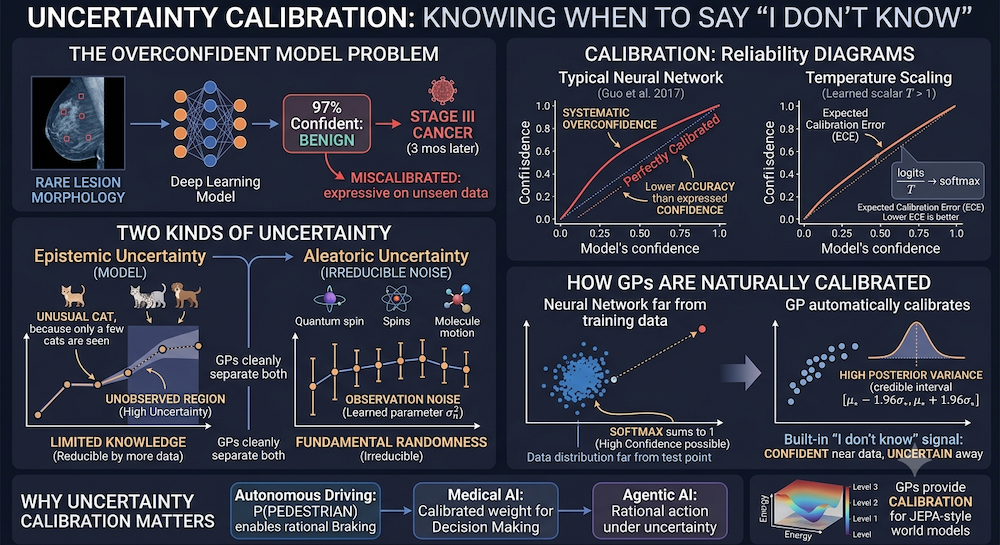
One day, the model processes an unusual scan — a patient with implants, a rare lesion morphology, something outside the training distribution. The model outputs: 97% confident: benign.
The radiologist trusts it. The patient goes home. Three months later, she returns with stage III cancer.
The model was not wrong because it was bad at cancer detection. It was wrong because it was miscalibrated: it expressed 97% confidence on an input it had never seen anything like, when the honest answer was "I don't know."
This is the problem that calibrated uncertainty quantification is designed to solve.
Guo et al. (2017) documented this phenomenon systematically. They measured the calibration of modern neural networks on ImageNet and found that larger, more accurate networks are more overconfident. As networks got better at classification, they got worse at knowing when they were uncertain. The confidence scores output by a softmax classifier do not reliably reflect the probability of being correct — especially for inputs far from the training distribution.
This is not a niche academic concern. It is a central failure mode of every major category of AI deployment, from medical imaging to autonomous driving to financial risk management to agentic AI systems.
Two Kinds of Uncertainty
Not all uncertainty is the same. Understanding the distinction between the two main types is essential for both modeling and interpretation.
Epistemic Uncertainty (Model Uncertainty)
Epistemic uncertainty arises from limited knowledge. Given more data, we could reduce it.
If we have seen only ten examples of cats and thousands of dogs, our model is highly uncertain about unusual-looking cats — not because cats are inherently unpredictable, but because we simply have not seen enough of them. The model does not know what to do with that input.
In Bayesian terms, epistemic uncertainty corresponds to the spread of the posterior distribution over model parameters or functions. Where data is sparse, many different models are consistent with the observations, and they make different predictions. The uncertainty is the disagreement among those models.
Key property: epistemic uncertainty can be reduced by collecting more data. It is the uncertainty we can do something about.
In a Gaussian Process, epistemic uncertainty appears as high posterior variance in regions with few observations. The GP explicitly tells us: "I'm uncertain here because I haven't seen much data in this region."
Aleatoric Uncertainty (Irreducible Noise)
Aleatoric uncertainty arises from fundamental randomness in the world. No matter how much data we collect, some outcomes remain unpredictable.
The position of a single molecule in a gas. The exact outcome of a quantum measurement. Whether a particular driver will run a red light in the next 10 seconds. The precise time a cell will divide. These are not predictable in principle — not because our models are bad, but because the processes that generate them are genuinely stochastic.
In a regression setting, aleatoric uncertainty is captured by the noise model where . Even if we knew exactly, our predictions would still have variance .
Key property: aleatoric uncertainty cannot be reduced by collecting more data. It is the irreducible floor of predictive uncertainty.
How GPs Separate the Two
In a GP with observation noise :
- Aleatoric uncertainty = (the noise variance, a hyperparameter learned from data)
- Epistemic uncertainty = diagonal of the posterior covariance
These are cleanly separated. When making a prediction, the GP can report: "My best estimate is , with epistemic uncertainty (reducible by more data) and aleatoric noise (irreducible)."
Standard neural networks conflate both into a single output — the softmax probability — making neither type interpretable. This is a fundamental architectural limitation, not a training failure.
Calibration: What It Means
A model is calibrated if its expressed confidence matches its empirical accuracy:
Among all predictions where the model says "80% confident," approximately 80% should be correct.
More formally: for a classifier outputting confidence scores , we want:
This is called the reliability property.
Reliability Diagrams
A reliability diagram visualizes calibration. Divide predictions into confidence bins (e.g., 0–10%, 10–20%, ..., 90–100%). For each bin:
- x-axis: average confidence score in the bin
- y-axis: fraction of correct predictions in the bin
A perfectly calibrated model produces a diagonal line from (0,0) to (1,1). Every point on the diagonal means "when I say %, I'm right % of the time."
A typical modern neural network (as documented by Guo et al. 2017) produces a curve that bows below the diagonal — for a given confidence level, the accuracy is lower than stated. This indicates systematic overconfidence: the model is more certain than it should be.
Expected Calibration Error (ECE)
ECE quantifies miscalibration as a single scalar:
where:
- = number of bins (typically 10 or 15)
- = number of predictions falling in bin
- = fraction correct in bin
- = mean confidence in bin
Lower ECE is better. A perfectly calibrated model has ECE = 0. Modern neural networks on ImageNet often have ECE in the range 3–8% (Guo et al., 2017).
Temperature Scaling
The simplest calibration fix is temperature scaling: divide the logits by a learned scalar before applying softmax.
- : softens the distribution (reduces overconfidence — the typical case)
- : sharpens the distribution (reduces underconfidence)
is fit on a held-out validation set by minimizing negative log-likelihood. This is a post-hoc fix — it does not change the model's predictions, only its confidence scores. It is fast, simple, and surprisingly effective for unimodal distributions.
Temperature scaling has limitations: it is a single scalar, so it cannot capture the location-dependent uncertainty that a GP provides naturally. It cannot distinguish "I'm uncertain here because there's little data" from "I'm uncertain here because the data is noisy." And it requires a well-calibrated validation set that reflects the test distribution — which is often unavailable in practice.
How GPs Are Naturally Calibrated
Gaussian Processes are calibrated by construction — under Gaussian noise assumptions and a correctly specified kernel.
The GP posterior provides a Gaussian predictive distribution at each test point:
where includes both epistemic and aleatoric uncertainty.
For a well-specified GP, the coverage property holds: the 95% credible interval should contain the true value 95% of the time in expectation. No post-hoc calibration is required — calibration is a consequence of the probabilistic framework, not a tuning step.
The geometry of GP uncertainty:
Uncertainty is high where data is sparse, low where data is dense. Near observed data points:
Far from data, both terms are small and — we fall back to the prior uncertainty.
Contrast with a softmax classifier far from training data:
A neural network with a softmax output can assign high confidence to inputs arbitrarily far from the training distribution. The softmax of any finite logit vector sums to 1, and there is nothing in the architecture that forces confidence to decrease for out-of-distribution inputs. The model cannot say "I've never seen anything like this."
A GP, by contrast, automatically reverts to prior uncertainty as inputs move away from training data. It has a built-in "I don't know" signal.
This is not just aesthetically nice — it is safety-critical. An autonomous driving perception system should be less confident about unusual road conditions it has never seen. A medical AI should flag that an unusual scan is outside its training distribution. A GP (or a GP-like architecture) does this by design.
Why Uncertainty Matters for World Models
The calibration problem is not merely academic. It is the central challenge for deploying AI in any domain where consequences are real.
Autonomous driving: a perception model that says "97% confident: no pedestrian" when it sees a low-light shadow in an ambiguous frame is dangerous. A calibrated model should say "60% confident" in that scenario, triggering the planner to slow down and gather more information. The planning system can then make a rational decision: "if there's a 40% chance that's a pedestrian, I should brake."
Medical AI: miscalibrated diagnostic confidence has caused documented harm in clinical deployments. When AI confidence scores are not calibrated, clinicians cannot correctly weight them in their decision-making.
Agentic AI systems: as AI agents take multi-step actions in the world (booking travel, writing and executing code, making financial decisions), knowing when to act with confidence versus when to ask for clarification is directly a function of the model's uncertainty about outcomes. An overconfident agent acts when it should not; an underconfident agent is paralyzed when it could safely act. Calibrated uncertainty enables rational action under uncertainty.
Connection to W13 JEPA:
The Joint Embedding Predictive Architecture (JEPA) learns an energy landscape over world states: low energy for plausible states, high energy for implausible ones. This energy function is an implicit uncertainty model — but it is not calibrated in the GP sense. We do not know what energy magnitude corresponds to "uncertain" versus "confident." The GP framework provides the calibration machinery that JEPA-style models currently lack.
For a world model to be actionable, its uncertainty must be in the same units as the decision's consequences. "High energy" is hard to put into a risk calculation. " that this route is blocked" is not.
The missing ingredient is a number:
Not "high confidence" or "low confidence" — a precise probability with a known error rate. When a model can say "" and be empirically right 73% of the time, we can build systems that reason rationally about that uncertainty: Bayesian optimal decision-making, risk-aware planning, graceful degradation when the model is out of its depth.
This is what GPs provide. And it is what the next generation of AI systems — world models, agentic systems, safety-critical AI — desperately need.
The Path Forward
W28 establishes the foundation: Gaussian Processes give calibrated uncertainty; Deep GPs extend this to hierarchical models; the GP–Transformer connection suggests that principled uncertainty can be incorporated into transformer architectures.
Coming up in this series: probabilistic 3D geometry — the Gaussian Splatting representations produce point estimates of 3D scenes; the next entry asks what a probabilistic 3D representation would look like — one that represents not just "where the surface is" but "how certain we are about where the surface is."
Further in the series: neuro-symbolic reasoning — how calibrated uncertainty enables reliable compositional inference in systems that combine neural and symbolic components.
Closing the arc: a probabilistic world model — an autonomous agent that maintains a probability distribution over world states, reasons about its own uncertainty, and plans under that uncertainty using principles from decision theory.
The gap between where we are and where we need to go is calibration. GPs — and the probabilistic tradition they represent — bridge it.